Pages

Friday, July 20, 2012

"Leading Ladies"


Playwright:  Ken Ludwig

VenueAurora Fox Studio, 9900 East Colfax Avenue, Aurora, CO

CompanyBackstage Theatre Company, Breckenridge CO

Date of Performance:  Thursday, July 19, 2012

Running Time:  2 hours, 15 minutes (includes 15 minute intermission).

Zach Andrews, in drag as “Maxine,” offers some useful advice for aspiring actors in “Leading Ladies:”

“Know your lines and don’t bump into the furniture.”

It’s good advice, of course, but it’s hardly enough to create a memorable theater experience.  And despite the efforts of Andrews and the rest of the cast, “Leading Ladies” ultimately falls victim to a script that wastes their talent.

Andrews (“Leo”) and Michael Bouchard (“Jack”) play dual roles in this comedy, each portraying traveling (and broke) Shakespearean actors, as well as two long lost sisters who stand to inherit a fortune. 

Down to their last dollar, Leo and Jack learn that Florence, a wealthy woman in York, PA, is about to die, and two of her three probably heirs have been out of contact for many years.  So, Leo asks, why not go for the gold and impersonate the long lost sisters who are unaware of their good fortune?   Never mind that Jack gives him compelling reasons to walk away.  The script requires them to plunge into what is clearly a fool’s errand.

Their scam requires Jack and Leo to convince the other characters that they are indeed the rightful female heirs to the fortune. It’s a funny enough concept, but it depends heavily on the actors’ ability to convincingly bend their genders from male to female.  To be sure, that is no easy task. 

Unfortunately, both Andrews and Bouchard fall well short of femininity; neither actor comes off as a passable woman.  The costumes did little to suggest a female form beneath them.  The wigs and the sack dresses screamed “cross dresser!” when they should have whispered ”hey…I’m a girl.”  Andrews and Bouchard are talented actors, but as Maxine and Stephanie, well, they’re still Leo and Jack.  They just changed their clothes.

The script is much too predictable, with two unfortunate exceptions.  First, Meg, whose wedding to Duncan is less than 24 hours away, declares her love for Maxine.  Somehow we’re supposed to believe that she has rejected her fiancé for a lesbian lover who’s clearly a male cross dresser.  Yes, it’s quirky.  It’s unexpected.  But it’s not credible, and it is neither funny nor dramatic.  It just comes off as very strange. 

The second unpredictable event was the final scene.  It’s a truncated performance of “Twelfth Night.”  The gratuitous nod to Shakespeare occurs after all the plot items have been resolved.  It adds no value to the story, and certainly does no justice to Shakespeare.

Sometimes a talented cast and crew can make a flawed script entertaining.  However, it is much more common that a flawed script will overcome a talented cast.  Unfortunately, “Leading Ladies” is a fine example of the challenge presented by an inferior script.

Take my comments with a grain of salt; perhaps I’m too jaded for “Leading Ladies.”  Some in the audience seemed genuinely entertained, but I was not one of them.

NOTE

This show runs through Sunday, July 21, 2012 at the Aurora Fox.  From there, it moves to the Backstage Theater in Breckenridge from July 26-August 19.

Director:  Missy Moore

Set Design/Construction:  Tina Anderson

Costume Design:  Julie Vance

Lighting:  Jen Orf

Sound:  Christopher Willard

Cast:

Rachel Bouchard (“Meg”)

Zach Andrews (“Leo/Maxine”)

Michael Bouchard (“Jack/Stephanie”)

Bethany Lillis (“Audrey”)

David Blumenstock (“Duncan”)

Edith Weiss (“Florence”)

Daymond Caylo (“Doc”)

Haydn Winston (“Butch”)

Photos courtesy Backstage Theatre Company

Monday, June 25, 2012

"Sweet Storm"


Sweet Storm

Playwright:  Scott Hudson

VenueMiner’s Alley Playhouse, 1224 Washington Avenue, Golden, CO


Date of Performance:  Sunday, June 24, 2012

Running Time:  1 hour, 25 minutes (no intermission).

To describe this play as “intimate” does not really convey how uncommonly personal it is.  The two actors portray the first 90 minutes of their marriage.  They’ve come straight from the ceremony to the handmade tree house where they will spend their wedding night.  What could possibly be more intimate, more personal, or more private? 

For the audience, it is a privilege to be admitted to such a special moment, but it also seems somewhat voyeuristic.  It’s an unusual premise, but one ripe with dramatic opportunities.  “Sweet Storm” is not about consummating the marriage, at least not in the usual sense.  Rather, it’s a window into a relationship between two people, and their personal relationships with God. 

Bo (Michael Bouchard) is a preacher, and Ruthie (Rachel Bouchard) is having a justifiable crisis of faith.  It’s awkward at times to watch them interact; they hardly know each other on their wedding day, and they barely know how to communicate with each other.  They are naïve, innocent, and yet bonded together in a new and unfamiliar way.
Ruthie asks the question that Bo has heard many times, and a question all of us have probably asked ourselves from time to time:  “Do you think we’re punished for the bad things we do?

It’s a central question.  Does God visit disasters on us for our transgressions?  Do we suffer because we’ve offended the Creator?  If we have faith and lead a virtuous life, why would God punish us?  Or is suffering random, just a matter of bad luck?  Bo’s faith is strong, Ruthie’s is understandably weak. 

Ruthie asks Bo “is luck in the Bible?”  Of course, luck is not in the Bible.  Luck is our way of rationalizing the randomness that intrudes on our lives.  But if luck is not the reason for Ruthie’s predicament, how can it possibly be explained or understood?  It is the questions Ruthie asks, and that Bo can’t answer, that power “Sweet Storm.”

That the actors here, Michael and Rachel Bouchard, are actually married to each other adds an interesting dimension to their performances.  They have shared their own intimate wedding night with each other.  They have had those moments, some of them no doubt awkward, where they began to understand each other on a very deep, personal level.  And that experience informs their sincere, strong performances.

Putting a tree house on a stage is a challenge, but Richard Pegg, Scenic Designer, has created a gem that is both realistic and functional.  The stage lighting includes a working kerosene lantern, which is exactly what one might find in a tree house.  Lighting and sound are combined effectively throughout the performance to put the audience in a continuous thunderstorm.

Robert Kramer’s direction exquisitely portrays the tension, the love, and the struggle the couple faces on their wedding night.  Kramer’s recent credits include “A Small Fire” at The Edge Theater, another intimate and powerful production, and one of my personal favorites of 2012.  “Sweet Storm” again demonstrates his skill for coaxing the most personal emotions from his actors.

Theater sometimes jars us into thinking about our own lives, and “Sweet Storm” is one of those thought provoking, rewarding experiences.  “Sweet Storm” may not give you the answers you seek, but it will force you to ask yourself the questions.

NOTE

This show runs through Sunday, July 8, 2012.

Director:  Robert Kramer

Scenic Designer/Construction:  Richard H. Pegg

Cast:
Rachel Bouchard (“Mrs. Ruthie Harrison”)
Michael Bouchard (“Mr. Boas Harrison”)


Sunday, June 24, 2012

"Footloose"


Stage Adaption:  Dean Pitchford & Walter Bobbie

Venue:  Lakewood Cultural Center, 470 South Allison Parkway, Lakewood, CO


Date of Performance:  Saturday, June 23, 2012

Running Time:  2 hours, 20 minutes (including 20 minute intermission).

I’m probably not the only one who remembers the 1980s with mixed feelings.  But I do recall the 1984 film “Footloose.”  It had a thin plot but marvelous dance scenes.  It wasn’t a film you remembered for the strong characters or the inspiring message (although there was a little of each if you watched closely).  But if you saw “Footloose” with Kevin Bacon dancing up a storm as Ren McCormack, you have not forgotten the experience.  The film was a triumphant celebration of dance, even if it wasn’t a triumph of filmmaking.

And by the way, if you didn’t see “Footloose” in the 80s, or the remake in 2011, you’ll still know some of the music.  The Kenny Loggins theme song played constantly on Top 40 radio back in the day.  Add “Holding Out for a Hero,” “Almost Paradise,” and “Let’s Hear It for the Boy,” and you’ve got a sing along musical confection from the moment the curtain goes up. This show is a high energy, foot tapping musical adventure of the first order.

For those who are unfamiliar with the story, young Ren McCormack moves with his newly divorced mother to Beaumont from Chicago.  Beaumont is a small town with a twist:  dancing is outlawed.  Ren sets out to single handedly change the culture of his new small town.  As he learns, “if you drive up a mountain, you can’t back down.”  Ren carries through on his quest to dance, and Performance Now carries through on their ambitious task—a script with a huge cast, challenging music, and frenetic dance numbers.  Performance Now and Ren follow a similar arc…neither will back down that mountain.

This production is strong in every respect; acting, singing, set design, choreography, music, costumes, lighting…everything just works.  But, as in the 1984 film of the same name, this show is really about the dancing.
 
And the dancing here is spectacular.  I’ll say that again, to let it sink in.  The dancing here is spectacular.

Spectacular dancing takes talented dancers, and there are plenty of them on the “Footloose” stage.  But it also takes inspired direction and precision choreography.  Here, the director and choreographer are the same person:  Kelly Van Oosbree.  She has an obvious connection with her actors, dancers, singers, and they reward her with career defining performances.  

The male and female leads (Joshua Bess and Chelsea Ringer) are magnetic.  There may be a dozen other actors on the stage with them, but you can’t take your eyes off Ren and Ariel.  They sing, they dance, and they light up the stage.

Bess and Ringer, though, have some tough competition for acting honors on the “Footloose” stage.  Joshua Kwaniewski (“Willard”) nearly steals the scenes he’s in with his comic timing, charming innocence, and warm smile.  Willard is the kind of guy we all want to hang out with.  Kwaniewski provides just the right dose of “redneck” attitude to go with Ren’s urban sophistication and Ariel’s rebellious struggle with her parents.

If you like musicals, with large dance production numbers, and catchy music done by a smoking hot band, do not miss “Footloose.”  And if you don’t like that kind of show, check your pulse, and then get a ticket while you can.  “Footloose” is fun, funny, and worth every penny.

NOTE: 

This show runs through Sunday July 1, 2012.

Director/Choreographer:  Kelly Van Oosbree

Cast (This is an abbreviated list; the entire cast includes 17 actors, actresses, dancers and singers):           

Joshua Bess (“Ren McCormack”)

Chelsea Ringer (“Ariel”)

Joshua Kwaniewski (“Willard”)

Tim Fishbaugh (“Reverend Shaw Moore”)

Anna Hardcastle (“Rusty”)


Friday, June 8, 2012

"The Roast Beef Situation"


Venue:  Buntport Theater, 717 Lipan Street, Denver, CO


Date of Performance:  Thursday, June 7, 2012

Running Time:  75 minutes, no intermission.

It doesn’t happen often, but every once in a while a production is so innovative, so creative, so inventive, that I hardly know how to describe it.  And with “The Roast Beef Situation,” words fail me.  It is unlike anything I’ve ever seen.  And that, frankly, is a good thing.

While the plot confounds, the premise is clear.  The Licensing Act of 1737 censored all theater productions in England.  Plays had to be approved by the government before they could be performed.  One of the more draconian requirements of the law required that theaters could not use any dialogue that was not accompanied by music.  That’s right.  No dialog without music.
Carlo Delpini, a professional actor, clown, and pantomimist, was imprisoned in 1787 for violating The Licensing Act by uttering the words “roast beef” without music.  It was, in his words, a “mistake.”  That “mistake” (“misteak?”) is the premise for “The Roast Beef Situation.”
Erin Rollman (Morey) and Erik Edborg (Grub) 
Buntport casts Delpini as the jailed protagonist, trying to rationalize his captivity and escape it in any way that is both possible and legal.  (It turns out that it’s legal to escape from prison in a boat, but it’s not possible.)  As for the lesser lunchmeats, well, you’ll have to see “Roast Beef” for yourself.
“The Roast Beef Situation” asks the obvious question:  does this law make sense?  And it also answers that question, with a random poll of 500 Londoners who think it does not make sense.  As Delpini says, “quelle surprise.”

The performances are engaging, exaggerated, and thoroughly entertaining.  The period costumes and makeup are surprisingly effective.  The white face makeup and the lipstick focus our attention on the facial expressions.  And those faces, at times, are as essential to the story as the script.

If we take “The Roast Beef Situation” simply as “food for thought,” one would quickly come to the conclusion that The Licensing Act of 1737 is misguided but irrelevant in 2012. 

Or is it?  Do we dare ask the contemporary question “do these laws make sense?” 

·      Foreign law has been banned in Kansas courts.
·      Pregnant women in South Dakota must be told that they have an "existing relationship" with the fetus before going through with an abortion.
·      It is illegal for undocumented immigrants in Alabama to get water in their homes.
·      Various states have enacted voter suppression laws, despite a lack of evidence of voter fraud.
·      The Wisconsin governor is attempting to prevent same sex couples from having hospital visitation access.

A lot has changed since 1737.  Unfortunately, silly, senseless legislation has not changed.  “The Roast Beef Situation” is a timely reminder of how the Ship of State sometimes veers far off course.

I was “plausibly perplexed” at times.  In the end, though, I was dazzled by the concept, the performances, and the challenge of “The Roast Beef Situation.”  This production is a unique experience that I recommend highly to all theater enthusiasts.  You will laugh, you will scratch your head, but you will not be disappointed.

This show runs through June 16, 2012.

Director:  Collaboration

Cast:           

Brian Colonna (Carlo Delpini)

Hanna Duggan (Stan)

Erik Edborg (Grub)

Erin Rollman (Morey)

Evan Weissman (Plausible Jack)

Wednesday, June 6, 2012

"In the Next Room...or the Vibrator Play"

PlaywrightSara Ruhl

VenueBug Theater, 3654 Navajo Street, Denver, CO


Date of Performance:  Tuesday, June 5, 2012

Running Time:  2 hours, 35 minutes, including one fifteen minute intermission.
Photo Credit:  C. Trammell/Oh Snap! Photography

As is my habit, I won’t spoil the story with too much information.  That said, though, it helps to know that it takes place in the late 19th century, near New York City, when the magic of electricity was just beginning to bloom.  And one of the blossoms was a mechanical vibrator that showed some value as a medical treatment for hysteria in (mostly) women.  The play depicts just such treatments, and the resulting “relief” it gave to the patients.  The first act is understandably comedic given the subject matter and the framework of 19th century values (which now seem less quaint than crazy).  

Needless to say, Dr. Givings’ (Charles Wingerter) patients are, shall we say, much more self aware and considerably less “tense” as a result of their “treatments.”

The second act moves abruptly from comedy to drama.  The contrast is stark but effective.  It seems the more self aware the characters become, the lonelier they are.  All of them fantasize about one of the other characters, but none of them can completely connect with that person.  And that is why this play is more relevant in the 21st century than it would have been in 1890.

Despite the title, the play itself is relatively tame.  There’s no nudity.  It’s not erotic.  It’s not vulgar or obscene, even though there are probably some adults who could be offended by some of the content. 

There are, however, some simulated orgasms achieved through mechanical means.  (And one that is achieved using a “manual” method.”)  I use the word “simulated” carefully here.  The simulations are very convincing.   Aimee Janelle Nelson (“Mrs. Daldry”) seems particularly gifted at portraying ecstasy.   Kaity Talmage-Bowers (“Mrs. Givings”) also displays considerable gusto for her “solo” performances. 

The standout performance here, though, goes to Adam Perkes (“Leo Irving”).  And that’s not just because he is marvelous to watch as he responds to “treatment.”  It’s also because he dares to push the sexual and racial boundaries of love in the 19th (and 21st) century.  And we are ultimately disappointed when we learn that doing so will make him lonely forever.

If you were hoping that “The Vibrator Play” would be all about mechanical self-gratification, you may be disappointed.  This play is about much more than that.  And it is very well presented here by Equinox, with a talented cast, an impressive set and tasteful, engaging direction from Deb Flomberg.

For a lot of reasons, technological, social, and emotional, the 21st century focus is more on fleeting pleasure (translation: “orgasm”) than on relationships.  We are too often connected socially but disconnected emotionally.  “In the Next Room…or the Vibrator Play” reminds us that this is not a new problem. 

This play won’t change your life, but it will make you think about the people you know, and your relationships with them.  And frankly, that’s more than enough reason to see this production.

NOTELeave the kids at home.

This show runs through June 16, 2012.

Director:  Deb Flomberg

Cast:           

Charlie Wingerter (“Dr. Givings”)

Kaity Talmage-Bowers (“Mrs. Givings”)

Aimee Janelle Nelson (“Mrs. Daldry”)

Linda Swanson Brown (“Annie”)


Arthur Pierce (“Mr. Daldry”)

Lisa Young (“Elizabeth”)

Adam Perkes (“Leo Irving”)


Monday, May 28, 2012

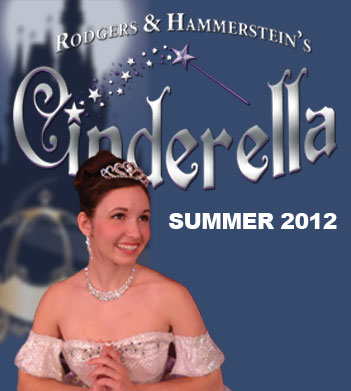
"Cinderella"


Jenna Bainbridge as "Cinderella" at Boulder Dinner Theater
Playwrights:  Richard Rogers and Oscar Hammerstein II (music, lyrics, book)

Venue:  Boulder's Dinner Theater, 5501 Arapahoe Road, Boulder, CO


Date of Performance:  Sunday, May 27, 2012

Standing around in the lobby at the Boulder Dinner Theater, waiting for the house to open, I immediately noticed something different about the crowd.  I guess I didn’t expect to see a large number of young girls (ages 4-40) in sequined slippers, tiaras, and dresses fit for a royal ball.  But there they were, chattering, giggling, and anxious to see the girl who met the prince at the royal ball. 

We all know the story.  Poor, pathetic Cinderella is brow beaten by her ugly stepsisters and her wicked stepmother.  She toils away in obscurity until her Fairy Godmother waves her magic wand and makes her the belle of the royal ball, where she meets her Prince Charming.

To take such a familiar story and tell it on stage is a challenge.  We all know how it turns out.  But despite the lack of suspense, the Boulder Dinner Theater nailed it.  Nailed it to the wall.  They breathed life, love, and inspiration into the story we all know by heart. And the audience is touched by the message that all things are possible:

“Because these daft and dewy eyed dopes keep building up impossible hopes, impossible things are happening every day.”

Strong singing voices are a threshold requirement for a musical.  Without good voices, nothing else matters. “Cinderella” blows by that threshold in Act I, Scene I.  The voices aren’t just adequate; they’re delightful.  “Cinderella” is replete with talented, strong, singing voices that bring the story to life. 

For Jenna Bainbridge, a veteran of the PHAMALY theater company, I’m sure this is a role she relishes.  Her enthusiasm for the role is obvious in every smile, every glance, and every line she delivers on stage.  There are aspects of Cinderella that parallel her own life; she has turned the impossible into the possible, and her theater dream into her reality.  And that, in part, is what makes her such a perfect actress for Cinderella.

Bainbridge not only brings her life experiences to the stage; she also brings her crystal clear singing voice and her impressive acting skills.  She is a joy to watch (and hear).  But she doesn’t need a glass slipper to prove that she’s the one we’ve been looking for.  We can tell when we first hear her sing, alone, on a darkened stage, lit by a single muted spotlight, during the overture.  Yes.  She’s the one.  We know it immediately.  She is Cinderella.

Matthew Daily plays the Prince, and he looks like, acts like, and sings just like the fantasy prince we all want for Cinderella.  He is our “Prince Charming” in every sense.  His chemistry with Cinderella is unmistakable. 

The entire cast is talented, animated, and fun.  The costumes are breathtaking, and Bainbridge’s costume change at the end of the first act is a feat of theatrical magic.  The entire production is a polished combination of on stage talent and backstage expertise. 

As for Alicia Dunfee’s skillful direction, one item stands out as especially inspired.  She cast Matthew Peters and Bob Hoppe in drag as the stepsisters (Joy and Grace).  Both make the most of his/her role, playing the sisters as hilarious caricatures.  As a result, the stepsisters are not your usual witch types.  Rather, they are fun, witty, and entertaining witch types.

There’s something very comforting about a story where the heroine gets the prince and everyone lives happily ever after.  No matter how many times we see that story, we’re charmed and inspired.  And what better way is there to walk out of the theater at the end of the show? 

NOTEThis is one of the best musical productions I have seen in a long time.  It’s also one of those all too rare live theater experiences that works superbly for children.  So take your kids to “Cinderella,” no matter their ages.  And then, take your friends and their kids.  It’s that good.

This show runs through September 1, 2012.

Director:  Alicia Dunfee

Cast:           
Jenna Bainbridge (Cinderella)

Ali Dunfee (Fairy Godmother)

Shelly Cox-Robie (Stepmother)

Matthew D. Peters (Joy)

Bob Hoppe (Grace)

Matthew Daily (Prince Christopher)

Seth Caikowski (Lionel)

Tracy Warren (Queen Constantina)


Tuesday, May 22, 2012

"The Misanthrope"


Playwright:  Molière (né Jean-Baptiste Poquelin)

Venue:  Germinal Stage Denver, 2450 West 44th Avenue, Denver, CO

Company:  Germinal Stage Denver

Date of Performance:  Sunday, May 20, 2012

How do you update a classic piece of theater written in 1666?  You start by introducing it with one of John Denver’s greatest hits, of course. 

"But the Colorado rocky mountain high
I've seen it rainin' fire in the sky
The shadow from the starlight is softer than a lullaby
Rocky mountain high"

Oh.  And move the play from Paris to Aspen, and set it in the 21st century.  And violà!  It works!

For those unfamiliar with the play, a misanthrope is a person who dislikes and/or distrusts people in general.  I think we all know a “misanthrope,” but we would use different terms today; rude, inconsiderate, self centered, and antisocial all come to mind.

Molière’s comedies often mock the upper classes, showing them to be shallow hypocrites and fools.  He writes in verse, and Germinal Stage Denver has very wisely used the Richard Wilbur translation.  Wilbur has deftly preserved Moliere’s wit and rhymes without losing anything in translation. 

The plot seems thin by today’s standards; Alceste gets into a huge dispute with Oronte.  The disagreement is over whether Oronte has any promise as a poet (he doesn’t), and whether Alceste could somehow be a little more sensitive in his criticism (he can’t). 

Molière also dabbles here in some more serious plot questions.  Are manners the enemy of truth?  Do men compromise all their convictions for a woman?  Actually, though, these questions are secondary to the comedy.  Molière will make you laugh, he will entertain you, and that, frankly, is the goal here.

Alceste (Terry Burnsed) is brilliant as the antisocial misanthrope.  He’s a cranky curmudgeon, and he doesn’t care in the slightest that he is exceedingly unpopular as a result.  He’s rude because he insists on telling the truth to people instead of exercising the false politeness that passes for manners.  He speaks truth to power…and to everyone else as well.

Alceste has a highly capable foil in Celimene, played by Julie Michalak.  She’s sassy, sexy, witty, and she knows how to handle the Misanthrope.  Michalak brings a perky feminine presence to the stage that makes us laugh at Alceste’s foolishness while she charms every male who takes the stage.  She may be from the 17th century, but she’s a modern woman in every sense.

The entire cast is very capable, and this production makes Molière fun again.
 
Even better than making Molière fun again is that director Ed Baierlein makes Molière relevant again.  Setting the play in contemporary Aspen reminds us that the “elites” are still an easy target for Molière’s wit.  Money may get you a condo near the ski lift, but it doesn’t cure the self-indulgent foolishness that often accompanies the privileged class.

I think if Molière were alive today, he might be a rap artist.  His rhyming lines and social commentary would make him a great collaborator with 50 Cent or Jay-Z.  Or perhaps he would be a comedy writer…and a very good one.  He can throw out zingers as well as the writers of “Big Bang Theory” or any other contemporary comedy.

As a long-standing Molière fan (we all have guilty pleasures, right?), I was definitely looking forward to this Germinal Stage Denver production.  It delivered.  I totally enjoyed the production and the performance.  If Molière is not your guilty pleasure, I get it.  But if you give it a chance, I think you’ll be glad you did. 

NOTE:  This is definitely a family show.  Kids might resist seeing something written in verse 340 years ago, but they might also be very surprised to find they like it.

This show runs through June 10, 2012.

Director:  Ed Baierlein

Cast:
           
Terry Burnsed (Alceste)

Julie Michalak  (Celimene)

Leroy Leonard (Philinte)

Eric Victor (Oronte)

Sam Gilstrap (Acaste)

Randy Diamon (Clitandre)

Mary Cates (Eliante)

Anne Smith Myers (Arsinoe)

Marc K. Moran  (Dubois)  

Sunday, May 20, 2012

"Bug"


Playwright:  Tracy Letts

Venue:  Dairy Center for the Arts, 2590 Walnut Street, Boulder, CO

Company:  Devil’s Thumb Theater Company

Date of Performance:  Saturday, May 19, 2012

Good theater entertains us.  Great theater challenges us.  Devil’s Thumb’s production of “Bug” is one of the biggest theatrical challenges I have ever encountered.  Does that make “Bug” great theater?  You will have to answer that question for yourself.

“Bug” is a dark, depressing descent into paranoia.  During this excursion into insanity, you will endure physical violence, fighting, emotional suffering, drinking, drug use, murder, and a tumultuous, tragic conclusion.  You will be challenged; this show is not for the squeamish. 

Graham Emmons plays Peter, the Gulf War veteran who has spent four years in a military mental hospital.  Peter introduces himself early in the first act by proclaiming that he is not “an ax murderer.”  That’s probably true, but it is ultimately not very comforting.  Peter cannot and does not live in the real world.  He is consumed by a perceived conspiracy of military doctors who have infected him with “bugs.”  Aphids.  Tiny, nasty creatures that get under your skin, lay eggs, and take over your body.

Emmons is completely convincing as a soft spoken, sensitive, and sincere victim of his war experiences, and his resulting insanity is equally convincing.  This is a physically and emotionally difficult role for any actor.  Emmons has mastered his craft.  He is a scary, convincing and ultimately tragic Peter Evans.

Kirsten Deane plays Agnes, the drug addicted loser who lets Peter live with her in her flea-bag motel room.  I don’t do spoilers, so I will just say that her performance is worth whatever you pay to see this show.  She makes the transition from troubled to insane before your eyes.  Her gradual retreat from reality is difficult to watch, but it is a performance that you will not easily forget.

Put Emmons and Deane on the stage with this strong supporting cast, excellent direction from Gregory Thorson, some outstanding fight choreography, and stunning makeup, and you have a recipe for the remarkable theater experience that Devil’s Thumb has served up for us. 

Great theater challenges us.  “Bug” challenged me.  It disturbed me.  It made me uncomfortable.  But without taking anything away from the performances and production, it also made me angry.  “Bug” challenges the audience to endure the insanity, but it offers no reward for the effort.  The characters learn nothing from their experiences, and there is no “takeaway” for the audience.  This is not in any sense a criticism of the performance.  Rather, it is a criticism of a script that gratuitously provokes, shocks, and disturbs the audience.  In fact, I left the theater feeling somewhat used, even abused, by a self-indulgent playwright. 

As inspired as this production is, I cannot give an excellent performance of an empty script a higher rating than I did below (3.75 on a scale of 0-5).  Feel free to disagree.  I’d appreciate any opinions you might have on “Bug.”  Comments are encouraged…

NOTE:  This is not a family show.  Be prepared for drug use, adult language, nudity, and graphic violence. 

This show runs through June 2, 2012.
Director:  Gregory Thorson

Cast:           
Kirsten Deane (Agnes White)
Graham Emmons (Peter Evans)
Haley M. Driscoll  (R.C.)
Sean Scrutchins  (Jerry Goss)
Scott G. Hartman (Dr. Sweet)