My heart is broken.
Linda passed away on Monday, May 6, 2013. She was diagnosed with breast cancer on May 2, 2006; we put in her hospice exactly 7 years later on May 2, 2013.
She was my wife.
She was my partner.
She was my lover.
She was my best friend.
I already miss her. I will never forget her.
She was a Henry Judge for the Colorado Theater Guild. Theater was her love and her passion. We spent many hours in theaters all over the front range, and she loved EVERY minute of it.
I have not been posting much lately, as Linda's health rapidly declined in the last few weeks. I spent most of my time recently supporting and caring for her. Many thanks to all who have helped me during the most difficult time of my life.
I hope to resume reviews soon; I know that's what Linda would want.
For those who tend to put it off, I ask you to honor Linda by doing regular breast self exams.
I want to thank Rick Yaconis at "The Edge Theatre" for dedicating the Monday, May 6 performance of The Shadow Box to Linda. I know she would have been surprised, proud, and ecstatic about the dedication.
Bill
https://www.facebook.com/bilweeler
Wednesday, May 8, 2013
Sunday, April 21, 2013
Always...Patsy Cline
![]() |
| Photo by Ronnie Gallup |
Written by: Ted Swindley
Producer: Starkey Theatrix
Running Time: 2 hours (includes 15 minute intermission)
Date of Performance: Saturday, April 20, 2013, 2:00 PM
John Moore, a very wise and widely respected theater critic, recently expressed the opinion that:
"Two things the new generation of self-starting blogger critics have in common: Almost none of them are paid anything close to gas money to write about theater. And, perhaps coincidentally—perhaps not—what they write is almost always insufferably, uselessly positive."
As a "self starting blogger critic," I fully agree. If one is going to "hold the mirror up to the artists," that mirror must include the warts. Although I am sometimes guilty as charged, I also point out the warts when necessary, such as here, here, and here.
However, despite Mr. Moore's excellent advice, I won't be reporting any warts for Always...Patsy Cline. That's not due to the reasons Mr. Moor points out in his opinion piece; rather, it's because there aren't any.
There are so many things done right in Always...Patsy Cline that it's difficult to know where to start. So here's a short list of what really works well:
1. The set is striking, and Director John Moore makes full use of all of it.
2. The band (The Bodacious Bobs) is excellent, and Moore puts them in the center of the stage, not in a pit. That's a great move; music is, after all, performance art. Seeing the performance as well as hearing it puts faces to the music.
3. The lighting, including follow spots for the actors as they stride all over the stage and into the audience, is precise, focused, and sharp.
4. The costumes range from basic (for Louise Seger, portrayed by Carla Kaiser Kotrc) to stunning (for Patsy Cline, played by Megan Van De Hey). Van De Hey performs at one point in a black sparkly evening gown that literally lights up the stage, and follows that with her skin tight gold lamé pants with cowgirl boots. Costumers Rae and Laurie Klapperich have expertly dressed their characters to bring out their separate but complementary personalities.
5. The multimedia (audio, video, photos) piece is projected on a giant screen behind the actresses. Sometimes these technical tricks intrude and detract; here they enhance and emphasize the story.
The real strength, though, of Always...Patsy Cline is the heartfelt and engaging performances by Megan Van De Hey and Carla Kaiser Kotrc. Both are at the top of their games, charming each other and the audience with their sincerity, humor, and love for each other.
Given the title, one would expect Patsy Cline to be the starring role here. But one would be wrong; these two actresses are the very definition of "co-stars." While music is certainly the focus of Always...Patsy Cline, there is also a story here, and they share equally in telling that story. It's about the unlikely relationship between a housewife and a celebrity that endured until Cline's death in an airplane crash in 1963. Van De Hey and Kaiser Kotrc have a special chemistry; the audience never doubts the love each has for the other as they tell their story.
Obviously, no musical production can succeed without excellent music. Always...Patsy Cline has Patsy's library of country hits, and they still sound great 50 years later. With the Bodacious Bobs providing the instruments and Megan Van De Hey the lyrics, one can actually believe for two hours that Patsy never died in that crash. Van De Hey looks like, and sounds like, the Patsy Cline America loved...and still loves.
Despite good advice to the contrary, I can find no warts in Always...Patsy Cline. Perhaps the director will forgive me for this "relentless sea of acidic sunshine." I certainly hope so, because in my view, Always...Patsy Cline is a very rewarding evening of music and memories, served up by an excellent cast and crew.
This show has been extended, but will close on April 27, 2013.
This is a family show; there's no vulgarity, no nudity, and no violence.
Director: John Moore
Scenic Design: Shaun Albrechtson
Lighting Design: Richard Spomer
Costumers: Rae and Laurie Klapperich
Musical Director: Jalyn Courtenay Webb
Cast:
Patsy Cline: Megan Van De Hey
Louise Seger: Carla Kaiser Kotrc
Also on stage: The Bodacious Bobs
Joe Bob: Piano (Neal Dunfee)
Jim Bob: Pedal Steel Guitar (Bob Case)
Billy Bob: Lead Guitar (Jason Tyler Vaughn)
Jay Bob: Bass Guitar (Scott Alan Smith)
Bob Bob: Drums (Dan Hoeye)
Saturday, April 6, 2013
The Other Place
Playwright: Sharr White
Company: Boulder Ensemble Theatre Company
Running Time: 85 minutes (no intermission)
Date of Performance: Thursday, April 4, 2013
We all believe that we are operating in a shared, structured world. Reality is, well, "real." It's fixed, constant, inflexible. Or so we believe.
Unfortunately, this belief is sometimes wrong. It can be valid 98% of the time, but there are those rare and disturbing times when "reality" as we know it utterly fails us.
Reality, ironically, is actually personal, subjective, and pliable. We define it with tiny electrical charges and chemical reactions in our brains, and then filter the results through our personal experiences. The truth is that sometimes the electrical charges and chemical reactions run amok, distorting our "reality." That distortion and loss of reality is at the core of The Other Place.
The story is told by Dr. Juliana Smithton (Rachel Fowler), who is obviously a brilliant biophysicist who works as a research scientist for a pharmaceutical company. As the show opens, she is lecturing a group of doctors who have traveled to the Virgin Islands to hear her pitch the revolutionary new drug the company has developed. The new drug, ironically, is designed to treat the disease she is developing before our eyes.
She's smart, sassy, focused, and professional, but she has an "episode" and becomes disoriented during her Power Point presentation. As we soon learn, she is losing her grip on her memories, her faculties, and her family.
![]() |
| Erica Young, Josh Hartwell, Rachel Fowler |
Rachel Fowler's performance is intense, moving gracefully from an intelligent professional woman to a confused, angry victim of episodic dementia. It would be an understatement to say Fowler does this well; her performance is inspired, convincing, and acutely personal. She connects with the audience in a way that makes us suffer the confusion, the frustration, and the anger with her. We cannot help but be drawn into the frightening "reality" she inhabits.
Josh Hartwell is magnificent as Smithton's husband; he is at times loving and supportive of his wife, and at times frustrated and angry with her. He's a reluctant but devoted caregiver, but he's also an oncologist, utterly unable to do what he is trained to do: treat and cure his patient. Hartwell plays the role with a perfect mix of the husband, doctor, caregiver, father personas that the script requires.
Erica Young plays multiple roles, which actually advances the story by giving Julianna's confusion some plausible context. Young moves seamlessly from character to character. Pay attention to her portrayal of a woman who comes home to find a stranger in her house. Young delicately mixes the surprise, the fear, and the sensitivity of the character in a way that is both appropriate and credible.
The Other Place literally takes us out of our comfort zone, to "the other place," where memories and reality are not what they seem. It's a disturbing detour from that comfort zone, and a must see theater experience. The Boulder Ensemble Theatre Company (BETC) has three hits in a row by my count, How the World Began and Ghost Writer being the other two. If you haven't seen something at BETC this season, you have missed what may be the best productions on the front range this year.
NOTES:
This show runs through April 7, 2013. A few vulgarities may offend some, but this play is otherwise suitable for teens and up. However, the subject is disturbing, especially if a loved one has suffered Alzheimer's or other dementia.
Playwright Sharr Wright is a graduate of Fairview High School, which is less than 5 miles from the Dairy Center where his work is making its Regional Premiere.
Director: Penny Walrath Cole
Scenic Design: Christopher M. Waller
Sound Design: Andrew Metzroth
Lighting Design: Steven McDonald
Costume Design: Charlotte Ballard
Cast:
Dr. Juliana Smithton: Rachel Fowler
Dr. Ian Smithton: Josh Hartwell
The Woman: Erica Young
The Man: Benaiah Anderson
Friday, March 29, 2013
Spamalot
Book & Lyrics: Eric Idle
Music: John Du Prez & Eric Idle
Venue: Buell Theater, Denver Center for the Performing Arts, 950 13th Street, Denver Colorado
Company: Phoenix Entertainment
Running Time: 2 hours, 15 minutes (includes 15 minute intermission)
I was never a big fan of Monty Python. I had a chance to see Spamalot at the Denver Center the last time it played Denver, but I turned it down. It was an expensive evening out that I didn't think I'd enjoy very much.
That's a mistake I will NOT make again. It turns out that you don't have to be a Python fan to appreciate the comic genius that is Spamalot.
The current touring production is in Denver for a very brief run (March 28-30), again at the Buell Theater. Opening night was a nearly full house, and the audience was fully engaged from the opening note of the overture.
If you haven't seen Spamalot, you don't have to worry about any spoilers ahead. The script is, to be delicate, not exactly a detailed, historically accurate story about Camelot. It's impossible to spoil the plot, which is loosely based on a search for the "Holy Grail."
The story (and that may be a generous characterization) is strictly a vehicle for the humor. If you're a Python fan, the humor is what matters, and here it runs the gamut from pratfalls to sight gags; from flatulence jokes to bad puns ("alms for the poor" is unforgettable). This touring production is spectacular; it even includes a Las Vegas style dancing and singing extravaganza ("what happens in Camelot stays in Camelot"). The choreography and music are splendidly executed, even as they sometimes skewer the very Broadway genre we are seeing ("The Song That Goes Like This" and "The Diva's Lament"). If you don't leave the theater humming "Always Look on the Bright Side of Life," check your pulse. You may need medical attention.
If there's a message for us in Spamalot (and I think there is), it's to find your place in the world:
"When your life seems to drift
When we all need a lift
Trim your sail
You won't fail
Find your Grail, Find your Grail"
Good advice, delivered with heart and humor.
Spamalot is, at its heart, an exquisite satire, giving us caricatures of British history, French rudeness, frolicking Finns, Jewish producers/performers, and most importantly, a stinging indictment of Broadway theater "entertainment." It's all in good fun, of course, especially if your favorite ox is not being gored.
If you're looking for your own Holy Grail, Spamalot is a great start for your quest.
NOTES:
This show runs through March 30, 2013. Suitable for tweens and up.
Director: Mike Nichols, recreated by BT McNicholl
Scenic Design: James Kronzer
Choreography: Casey Nicholaw, recreated by Scott Taylor
Sound Design: Craig Cassidy
Lighting Design: Mike Baldassari
Cast (main characters):
King Arthur: Arthur Rowan
Sir Lancelot: Adam Grabau
Sir Dennis Galahad: Joshua Taylor Hamilton
Lady of the Lake: Abigail Raye
Saturday, February 9, 2013
Dark Wood
Playwright: Peter McGarry.
Venue: Denver's Dangerous Theatre, 2620 W. 2nd Avenue, Denver, CO 80219.
Company: Denver's Dangerous Theatre
Date of Performance: Friday, February 8, 2013
Running Time: 90 minutes (no intermission)
If you venture to a venue named "Denver's Dangerous Theatre" (DDT), you are entitled to expect some edginess, some risk taking, and perhaps some mold breaking. With Dark Wood, DDT breaks the mainstream entertainment mold and smashes some theatrical "china" as well.
Fair warning: Dark Wood is not another night at the theater. The all male cast is naked for the entire performance. While the nudity is decidedly not erotic, it is nevertheless an element that the audience must deal with immediately. I should mention that, for good measure, the script is also laced with profanity.
The pertinent question for a production like "Dark Wood" is whether the risks taken are a) gratuitous or b) justified. The answer, at least for me, is that the nudity and street language are both justified by the premise of the play.
![]() |
| Patrick Call. Photo: DDT |
Two of the primates ("Rico," portrayed by Patrick Call, and "Strong Arm," played by Ben Pelayo) were born in captivity; the third (Mbwane, aka Brainard Starling) was captured in the forest. The play revolves around the comfort of captivity for Rico and Strong Arm and the contrast to Mbwane's lost freedom.
![]() |
| Ben Pelayo. Photo: DDT |
As the two zoo primates get to know Mbwane, their understanding of their existence is challenged. They are confronted with difficult questions: do they simply exist in captivity, or do they live in a different "freedom" from creatures of the forest? Are they prisoners? Can they escape? Should they escape? Could they live without the "feeders" who feed and care for them?
![]() |
| Brainard Starling. Photo: DDT |
Mcgarry's script draws its themes from 20th century existentialist philosophers. Writers like Jean-Paul Sartre explored these same themes; what does it mean to exist, what is our purpose, are we free, and indeed, can we ever be free?
The beauty of Dark Wood is that it forces the audience to confront their own existence, to ask if their lives have meaning, or whether they are simply captives in a zoo of their own making. Which side of the cage are we on...the inside or the outside? The answers are not simple, but the inquiry is valuable.
The cast here is a strong ensemble, each contributing a different and very distinct "monkey" personality. Nudity, for actors, is akin to circus performers working without a net. It is totally honest; one cannot hide any physical or theatrical flaw. This cast has the courage to expose themselves to ridicule; playing naked monkeys is to potentially turn oneself into the butt of obvious jokes (puns intended). They take that challenge seriously, even eagerly, and turn those jokes into serious theater.
Dark Wood is certainly not for everybody. It is for those who are not afraid to give at least as much consideration to their own existential purpose as they do to planning their next vacation. As Sartre would say, we have freedom, but not everyone takes advantage of it.
“A human being who wakened in the morning with a queezy stomach, with fifteen hours to kill before next bedtime, had not much use for freedom.”
DDT and Dark Wood deliver on the promise of "dangerous" theater. If you have the courage of this cast, and if you care to examine your purpose in life instead of killing the 15 hours before bedtime, Dark Wood is your show.
NOTES:
This show runs through April 26, 2013.
This show is not suitable for children; recommended only for 18 years and up. This show has extensive nudity. The nudity is natural, rather than erotic or sexual. Recommended only for mature audiences who can see absorb the message without squirming over the raw, naked delivery. Remember: it's not called Denver's Dangerous Theatre for nothing.
Director: Winnie Wenglewick
Cast:
Rico: Patrick Call
Strong Arm: Ben Pelayo
Mbwane: Brainard Starling
Tuesday, February 5, 2013
Over the Tavern
Playwright: Tom Dudzick.
Venue: Longmont Performing Arts Center, 513 Main Street, Longmont, CO 80501.
Company: Longmont Theatre Company
Date of Performance: Saturday, February 2, 2013
Running Time: 2 hours, 30 minutes (includes 15 minute intermission)
For those of you who don't remember the 1950's, you probably think it was a time of innocence, simplicity, optimism, and prosperity. That's partly true, but not completely. There were conflicts, Communism, the Cold War, a nascent Civil Rights movement, and a host of other social issues. LIke any time in our history, it was more complicated than we may remember.
Over the Tavern takes us back to those days, and does so with a focus on the innocence and the fun of the period, but also with a revealing take on the forgotten realities of that period.
The play takes place in the Pazinski home, "over the tavern" the father operates. With four kids, and a resident alcoholic grandfather, the budget is tight. Chet Pazinski (portrayed at high volume by Greg Winkler) runs the tavern but is only marginally present as a father. He suffers from "bad moods" which routinely terrorize the dinner table. Chet's wife, Ellen (Krystal Jakosky) does her best to protect the family from Chet's rants.
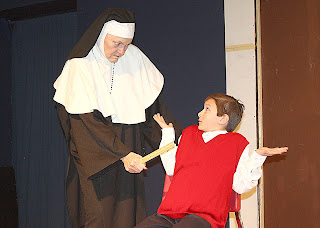
The Pazinski family is Catholic, and the children attend Catholic schools. That puts them in direct contact with Sister Clarissa (Marian Bennett), the stereotypical mean spirited nun who will rap your knuckles if you don't know your Catechism.
![]() |
| Marian Bennett/Peter Cabrera. Photo credit: LTC |
The four children are a motley but engaging crew. Georgie (Ben Neufeld), who is "retarded," is endearing with a simple but adorable personality. Annie (Montana Lewis), the overweight teen girl with no self esteem, is struggling with her transition in becoming an adult woman. Eddie (Beau Wilcox) is the teen boy whose primary focus is magazines with naked women.
And that leaves us, finally, with Rudy (Peter Cabrera), the youngest Pazinski.
Cabrera is perfect in the "Rudy" role, giving us a mischievous, charming, and articulate foil to Sister Clarissa. Rudy, it turns out, is not sure he wants to be confirmed as a "soldier for God." Instead, he's shopping around for a more "fun" religion. Rudy so confounds and frustrates Sister Clarissa that she actually has a heart attack.
Over the Tavern is a lot of fun; the laughs fly fast and furious throughout the show. Despite those laughs, you never forget that there are serious issues here, including faith, abuse, and borderline poverty. It's a serious message delivered with a big helping of humor.
There are four child actors here; all four are outstanding in their roles. That said, though, it is Peter Cabrera's Rudy who nearly steals the show. His performance alone is worth the price of a ticket. He may be only eleven years old, but he's a pro when he walks on the stage.
The show is well done, although a flickering light on the set was distracting. Those things happen, but that doesn't change the fact that Over the Tavern is a good time for the whole family. It's a reminder for all of the us that the myths of the 1950s gloss over the unpleasant realities. Raising kids is very hard work. It doesn't matter what decade you do it in.
NOTES:
This show runs through February 9, 2013. Suitable for the whole family.
Rudy/Peter: Please keep looking for the "fun" in your life. Too often we adults neglect to follow your example.
Director: James Carver
Lighting Designer: Brian Curtiss
Scenic Design: James Carver
Sound Design: James Carver, Chris Parr
Costume Designer: Judy Ernst
Co-Producers: Judy Ernst, Tracey Cravens
Cast:
Sister Clarissa: Marian Bennett
Rudy Pazinski: Peter Cabrera
Ellen Pazinski: Krystal Jakosky
Annie Pazinski: Montana Lewis
Georgie Pazinski: Ben Neufeld
Eddie Pazinski: Beau Wilcox
Chet Pazinski: Greg Winkler
Monday, February 4, 2013
Ghost-Writer
Playwright: Michael Hollinger.
Company: Boulder Ensemble Theatre Company
Date of Performance: Sunday, February 3, 2013
Running Time: 90 minutes (no intermission)
The premise of Ghost-Writer is simple but engaging: set in 1919, novelist Franklin Woolsey dies in mid sentence while dictating a new novel to Myra, his typist. She continues to type, and finishes the book months after his death. From this premise comes a marvelous drama about the process of writing, a forbidden love, and the source of artistic inspiration.
Hollinger's script is a work of rare beauty. His novelist, Woolsey, is a writer who dotes on the details, the punctuation, and the tone of his work. Fittingly, so does Hollinger. He gives us a focused, polished story; every line is essential, not a word is wasted. The quality of Hollinger's writing is impressive; he has a gift for using an extensive vocabulary without making the actors seem pretentious.
Director Josh Hartwell is working with an extremely accomplished cast, and he has made the most of their talents. He mixes dialog with extended pauses, making the creative writing process both visible and credible. Hartwell's skill with his actors is on full display in two striking scenes: his staging and lighting of the dance and the last scene are both exquisite.
![]() |
| Laura Norman. Photo Credit: BETC |
In a sense, this could be considered a one woman show. Laura Norman is not just the typist; she is the focus and the force on the stage. She doesn't portray Myra Babbage; she IS Myra Babbage for 90 minutes. Her gestures and her facial expressions are the visual punctuation for Hollinger's prose. Her low key delivery deftly reveals Myra's loyalty to Woolsey and her thinly disguised sexual attraction to him. Norman's final scene is powerful; you will not soon forget the simultaneous grief and relief she displays as the lights go down.
While Babbage/Norman is the focus, both Jim Hunt and Anne Sandoe shine as the Woolsey couple. Hunt is the stodgy curmudgeon novelist who has a complicated relationship with his typist. Sandoe is the jealous wife who knows that she is losing her spouse to a rival with whom she cannot compete. Both bring their A games to their roles.
If you haven't yet figured out how I feel about this performance, let me make it clear. Ghost-Writer is extraordinary. Everything here works; lights, sound, set, costumes, actors, director, and script are flawless. When all these elements come together, the whole is much greater than the sum of the parts. To say that the experience is rewarding does not begin to convey the power of the performance. Ghost-Writer is a must see. Although it's early, I feel I can begin compiling my "Best of" list for 2013. Ghost-Writer will be competing for a top spot on that list.
If you haven't noticed, the Boulder Ensemble Theatre Company is having an outstanding season. Ghost-Writer has a short run (it closes on February 16). If you can't make it by then, try to get to one of the coming attractions. They look very promising.
In conclusion, if you've seen the play, you know that Ghost-Writer has given me a suitable phrase to conclude my thoughts here:
"Well, I suppose that's about it..."
NOTES:
This show runs through February 16, 2013. There's nothing here that would be objectionable for children, but the subject matter would not interest most kids. The discussion of whether an apostrophe is correctly used would probably send them running to the parking lot.
One of the unintended benefits of Ghost-Writer is the effect it had on composing this post. I can assure all readers that I have very carefully reviewed my spelling, punctuation, and grammar before posting. If anyone would like to dispute the use of an apostrophe or a semi-colon, please leave me a comment. I'd love to have that discussion...
Photo Credits: BETC
Director: Josh Hartwell
Set Design: Megan Chaney
Lighting Design: Kerry Cripe
Sound Design: Andrew Metzroth
Costume Designer: Brenda King
Cast:
Myra Babbage: Laura Norman
Franklin Woolsey: Jim Hunt
Vivian Woolsey: Anne Sandoe
Thursday, January 31, 2013
"Noises Off"
![]() |
| Photo Credit: Lone Tree Arts Center |
Playwright:
Michael Frayn.
Venue: Lone Tree Arts Center, 10075 Commons
Street, Lone Tree, CO 80124
Company: Co-produced by Lone Tree Arts Center
and Starkey Theatrix
Date of Performance: Wednesday, January 30,
2013
Running Time: 2 hours, 15 minutes (includes one 10
minute one 5 minute intermission)
Although I’ve seen a lot of
theater over the years, I’ve never been backstage at a dress rehearsal hours
before the opening performance. Of
course, I’ve never seen how sausage is made either. The difference is that sausage making is not fun to watch,
while the dress rehearsal in Noises Off
is hilarious. I think I can say,
without spoiling any of the fun, that Noises
Off successfully demonstrates how a production can go off the rails and
descend into insanity and hilarity.
A “play within a play,” Noises Off is a complex, layered,
frenetic script offering substantial challenges to the director (Nick Sugar)
and the cast. The actors are
playing dual roles here, first as “actors” and second as the characters they
portray in “Nothing On,” a play that
is always near collapse both on and offstage.
![]() |
| Photo credit: Lone Tree Arts Center |
Sugar has assembled an
experienced and talented cast that is more than equal to the challenges. Precise comedic timing is an essential
element for Noises Off, and the cast
is consistently amazing for hitting their marks at exactly the right time. Michael Bouchard (“Garry”) Anna Gibson
(“Brooke) Evan Marquez (“Freddie”) and Lauren Bahlman (“Belinda”) are the
center of gravity around which the other characters orbit. Their timing, gestures, facial
expressions, and delivery sell the action and entertain the audience at every
turn.
Anna Gibson (“Brooke”)
stands out here as an airheaded actress who doesn’t realize she’s
unintentionally hysterical. She is
not just endearingly ditzy, but she also heats up the stage with her costume
(which appears to be lingerie from Fredericks of Hollywood). She never seems
to notice that she is usually the only one onstage in underwear, and acts as if
it’s all perfectly normal. At one
point, in fact, she offers to take it all off (she doesn’t), as if that would
somehow solve some problems.
Evan Marquez (“Freddie”) has
mastered physical comedy, and even manages to climb a flight of stairs with his
pants around his ankles. (His Union Jack boxers are a hoot.) His facial gestures are deliciously exaggerated
as he reacts with what appears to be genuine surprise at the developments.
The first act drags a
little, but it’s essential to setting up the chaos of the second act. There is a lot of physical comedy here…so
much so that it’s exhausting just watching the actors.
If I have a quibble with the
production, it’s that the program does not credit the set designer. Presumably, the credit goes to both the
Lone Tree Arts Center and to Starkey Theatrix. The 360 degree set is striking in its functionality and
detail. It sits on a turntable,
and can display both the onstage action and the backstage chaos. The set here is as important as the
characters; I think the designer deserves a mention in the program. In any event, a tip of my hat to whoever was responsible for putting that set together.
I had a great time watching
this performance. Noises Off is engaging, charming,
entertaining, and hilarious. It definitely
gets my recommendation. However, it’s
a pretty short run (through February 10), so if you’re interested, you need to
book tickets soon.
NOTES:
This show runs through
February 10, 2013. Noises Off may not be appropriate for
young children due to some vulgar language in the first act.
If you haven’t been to the
Lone Tree Arts Center (west of I-25 at Lincoln), you haven’t seen one of the
newest and finest theaters in the area. The Main Stage Theater seats nearly 500, but feels much more
intimate. It’s a great venue, and
the line up of coming attractions is impressive.
Director:
Nick Sugar
Lighting Designer: Jacob Welch
Producers: Starkey Theatrix & Lone Tree Arts
Center
Costume Designer: Linda Morkin
Cast:
![]() |
| Trina Magness, Michael Bouchard, Evan Marquez. Photo credit: LTAC |
Dotty: Trina Magness
Brooke: Anna Gibson
Garry: Michael Bouchard
Poppy: Rachel Bouchard
Belinda: Lauren Bahlman
Freddie: Evan Marquez
Selsdon: Ron Welch
Tim: Scott Cahoon
Lloyd: Kurt Brighton
Saturday, January 19, 2013
RFK: A Portrait of Robert Kennedy
![]() |
| Photo credit: Vintage Theatre |
Playwright:
Jack Holmes.
Venue: Vintage Theatre, 1468 Dayton Street, Aurora,
CO
Company: Vintage Theatre
Date of Performance: Friday, January 18, 2013
Running Time: 2 hours, 10 minutes (includes 15 minute
intermission)
They say that everyone
remembers where they were and what they were doing on November 22, 1963. I know I do.
I was in Mrs. Muckenhirn’s 5th
period sophomore English class at West High School in Madison, Wisconsin. Just after 1:00, we got an announcement
over the loudspeaker. President
Kennedy was shot and killed in Dallas.
Classes were dismissed. I
remember getting my coat and waiting at the bus stop a block away at the corner
of Regent and Allen Streets. A
light rain fell as I waited for the bus, trying to process the unthinkable
reality of that day.
We all bring some baggage to
the table when the subject is the Kennedys. Love them or hate them; few are neutral. Consider the above information to be my
full disclosure. RFK:
A Portrait of Robert Kennedy is a history lesson for most, but for me,
it’s reliving a reality. My sophomore,
but hopefully not sophomoric, reality may affect my review. Take it for what its worth.
James O’Hagan-Murphy
delivers an intense, personal RFK.
He walks about the small stage, recounting the learning experiences he
endured from 1963 to 1968. Many of
those experiences were traumatic, including the assassination of his
brother. O’Hagan-Murphy’s one-man
performance is inspired; he commands the stage as the Attorney General, as the
junior Senator from New York, and as the candidate for President in 1968. I knew RFK in these roles because I was
a politically aware young adult at the time.
What I didn’t know was RFK’s
role as a husband, father, brother, and as a man. It is those moments where O’Hagan-Murphy shines,
reminding us that RFK was much more complex than the political images we
remember. He enjoyed football, his
kids, meeting celebrities (yes…that includes Marilyn Monroe), and jumping into
dangerous waters. Literally.
O’Hagan-Murphy tells the
story of RFK meeting a six year old girl in a dilapidated building in the
Bronx. He tries to connect with
her, but she won’t meet his gaze.
O’Hagan-Murphy’s passionate portrayal of the incident elicits audible
gasps from the audience as he tells the story.
Director Terry Dodd has used
the small room to great advantage.
O’Hagan-Murphy moves constantly from stage left to stage right, telling
stories, and making direct eye contact with each and every person in the
audience. You cannot avoid his
eyes; he locks on to you. Dodd and
O’Hagan-Murphy have made the experience intensely intimate and personal.
The blocking and lighting
are magnificent; O’Hagan uses the entire stage, but every move appears
natural. Despite his apparent meandering
about, he is never in the dark.
The subtle but unmistakable
truth sewn into the fabric of RFK: A Portrait of Robert Kennedy is
that not very much has changed since 1968. We are still a divided country, we still fight unjustified
wars, and we still tolerate poverty and racism in the most affluent country in
the world. Whoever said “those who don’t know history are destined to
repeat it” was obviously right.
Unfortunately, it also seems true that knowing history does not cure our
historical failures.
If I haven’t yet made myself
clear, RFK: A Portrait of Robert Kennedy is a total winner. Perfectionists may quibble of the
quality of O’Hagan-Murphy’s Boston accent, or over the somewhat humorless two
hours of RFK as a ruthless practitioner of hardball politics. I have no such reservations about this
production. It is engaging,
enlightening, entertaining, emotional, and at times inspiring.
Whatever your political
persuasion, you will benefit from seeing RFK: A Portrait of Robert Kennedy. If you don’t care for Kennedy and his
politics, you will still be impressed with his resilient personality and his
undisputed accomplishments. If you
see the world as RFK did, you may be surprised to see his temper, his flaws,
and his humanity. He was not the
idol on a pedestal that some mistook him for, nor was he a rich, isolated,
liberal elite as his enemies believed.
The truth is somewhere in between.
Vintage Theatre, James O’Hagan-Murphy, and Terry Dodd have given us a behind the scenes look at RFK, the ambitious but flawed man who didn’t get to finish his mission.
We are left with the
ultimately futile question of “what if RFK had not been cut down at the
Ambassador Hotel in Los Angeles on June 6, 1968?” Of course, we can’t know the answer. “RFK: A Portrait of Robert Kennedy” can
only remind us of what might have been.
That is an opportunity that no local theater fan should miss.
![]() |
| Photo credit: Wikimedia Commons |
“Some men see things the way they are
and say, 'Why?' I dream things
that never were and say, 'Why not?”
Robert F. Kennedy
NOTES:
Originally scheduled to run
through January 27, RFK: A Portrait of Robert Kennedy has been extended through February 24,
2013. Purchase tickets here.
Director:
Terry Dodd
Sound Designer:
Luke Terry
Lighting Designer: Luke Slotwinski
Set Designer: Terry Dodd/David LaFont
Cast:
Robert F. Kennedy: James O’Hagan-Murphy
Subscribe to:
Posts (Atom)


