Pages

Saturday, March 15, 2014

"5 Lesbians Eating a Quiche" 2014 version.

Playwrights:  Evan Linder & Andrew Hobgood
Venue:  First Divine Science Church of Denver, 1400 Williams Street, Denver, CO 80218.
Running Time:  1 hours, 15 minutes (no intermission)
Date of Performance:  Friday, March 14, 2014 
I saw Square Product's production of 5 Lesbians in 2012; it was a hoot.  Their current remount has nearly all of the original cast, and all of the same silly fun, witty dialog, and feminine charm of the original production.  
5 Lesbians is set in 1956 at a meeting of the officers and members of The Susan B. Anthony Society for the Sisters of Gertrude Stein.  The membership demographics skew heavily towards widows.  There are no men in the crowd, by design.
It's the annual Quiche Contest meeting, and the anticipation of finding the perfect quiche made from the perfect egg with the perfect combination of vegetables is at a fever pitch.  (The perfect quiche cannot contain any meat.  You have to see the show to figure out why.)  
As the thespians/lesbians open the contest by sampling the first quiche, you'll be treated to what has to be the best (and only) onstage demonstration of a food fetish I've ever seen.  Adjectives fail me here, so I'll just describe that scene as a memorable and "tasty" aphrodisiac.
L-R:  Jessica Robblee, Laurie Lynch, Michelle McHugh Moore, Emily K. Harrison, Lindsey Pierce.
As in the 2012 production, the ensemble is over the top, preening and posing at every opportunity.  They are truly "sisters" onstage, each playing off the other caricatures and characters.  Emily K. Harrison reprises her role as Dale, a lesbian with father issues who hasn't spoken to a man since she was three years old.  Her poignant story of her older sister's demise is one of the few tender moments in the script.  Harrison has the dramatic range and the comedic chops to be a character in the midst of four other caricatures.
Laurie Lynch (Vern) is the "Girl Scout" in the group.  She's out, she's butch, and she's full of bluster.  Lindsey Pierce (Wren) is feminine, dignified, and full of mischief.  Pierce's costume and hair were perfect for her role.  Michelle McHugh Moore (Lulie) is the President of the "Sisters," and she struggles constantly to maintain control of the chaos.  
Jessica Robblee (Ginny) thinks she's straight, but discovers her hidden attraction to women.  Robblee has a crucial role in the cast; not only must she convincingly discover her true nature, but she also has a central role as an enthusiastic quiche lover.  She handles both of these delicate situations like an intelligent but innocent character would.  In the hands of a lesser actor, 5 Lesbians would not be nearly as entertaining.
Entertaining, in fact, is exactly how to describe 5 Lesbians Eating a Quiche.  The show is fun for all who are open to the adult theme.  
I'm going to indulge myself now and get on my soap box.  Feel free to skip the rest of this review if you'd rather not hear the sermon.
I couldn't help but consider how much has changed since I saw 5 Lesbians in 2012.  There's a line in the show that hopefully states that in four years (1960), "we can probably get married."  Of course, that didn't happen.  
Nevertheless, since the last Square Product version of 5 Lesbians, nine (9) states have legalized same sex marriage (bringing the total to 17 states).  Court rulings currently on appeal would make marriage equality the law in five more states (Utah, Oklahoma, Kentucky, Virginia, and Texas).   In fact, it appears that marriage equality may run the table in courts all over the country, including Colorado.
Marriage equality is on the way to becoming the rule instead of the exception.  Is that because of Square Product and other media and entertainment options that show gay and lesbian characters as our fun, charming friends and neighbors?  Probably not, but it would be naive to say the arts have no impact at all.  Square Product, in fact, can take credit for reminding us that lesbians are our sisters, our daughters, our friends and our neighbors.  Not only are they people we know...they are also the people we love.  
Despite all the tragedies (9/11), disappointments (officially sanctioned torture), and hardships (Great Recession) we have known in the first decade of the 21st Century, marriage equality is a beacon of hope and inspiration.  Art, film, and theater, including Square Product, are part of that beacon.  
There were many couples in the audience who came to see a show that they can relate to, that entertains them, and that doesn't marginalize them.  Thank you, Square Product, for giving dignity and respect to all in your audience.  
As far as I know, there is no local "lesbian" theater company, catering to primarily to that niche audience.  Perhaps we need one.  Perhaps Square Product should be that company.  
Playing to a small slice of the potential audience is risky, but the rewards are huge.  I know a lot of theater fans who would not hesitate to see good theater, no matter the niche.  Consider PHAMALY.  It's focused on disability issues, but their high quality productions attract diverse audiences and show disabled individuals as performers with amazing talent.
The Square Product mission statement includes "change":
"The mission of square product theatre is to create and collaborate on original, honest and innovative works of theatre with local and national artists...(W)e dedicate ourselves fully to the beauty of simplicity and the importance of theatre and performance as a vehicle for communication, relation and change."
If I were writing this mission statement, it would be shorter and simpler.  But since I'm not writing it, I'll just suggest one revision.  Perhaps it's time to revise the last line to "equality and change."   

NOTES:  
The venue is a church basement, and given the setting for the play, it's a very appropriate location.  There was a church dinner event going on at the same time as the play.  While some may see an incongruity between church activities and dramatic lesbians, it was comforting to see each group's acceptance of the other.
Arrive early enough to find a parking place.  There is limited church activity parking available on the north side of the building.  Otherwise, expect an extensive tour of the nearby blocks searching for street parking.
This show closes on March 22, 2014.  
This show is suitable for adults of all ages.

Pre or post show dining suggestion:  
This theater is sandwiched between Cheesman Park and East Colfax.  In other words, it's not exactly in the middle of a lot of great restaurants.  
I traveled from Colorado Springs, stopping at The Rockyard American Grill & Brewing Company in Castle Rock.  Expect very good craft beers and typical brewpub grub.  Try the Firebird sandwich; it's one of the best buffalo chicken sandwiches I've found.

Director:  Joe Gill
Production Manager:  Rand Harmon  
Set/Costume/Properties Design: The Ensemble
Lighting Design:  Jess Buttery
Sound Design:  Rebecca Easton & Emily K. Harrison

Cast:
Wren Robin:  Lindsey Pierce
Vern Schultz:  Laurie Lynch
Dale Prist:  Emily K. Harrison
Ginny Cadbury:  Jessica Robblee

Lulie Stanwyck:  Michelle Moore

Monday, March 10, 2014

All My Sons

Playwright:  Arthur Miller

Company:  Thunder River Theatre Company

Venue:  Thunder River Theatre Company, 67 Promenade Court, Carbondale, CO 81623

Running Time:  2 hours, 15 minutes (includes 10 minute intermission)

Date of Performance:  Sunday, March 9, 2014 


There is little debate; Arthur Miller is a giant of 20th century American theater and a Pulitzer Prize winner in 1949 for Death of a Salesman.  He won a Tony Award for All My Sons in 1947, his first Broadway venture, establishing himself as a serious playwright.  His work is still produced regularly more than 60 years later, proof of the timelessness and universal themes in his work.

Thunder River's production of All My Sons is a solid one.  Director Lon Winston obviously appreciates Miller's insight into some deep moral questions.  Winston's (and Miller's) characters hold up a mirror to each of us, challenging us to sift a meaningful message from the emotional debris we all have to deal with.

Miller's script sets up a complex moral dilemma:  are "family" values (providing financial and moral guidance to loved ones) more important than the "social" values we owe our fellow citizens?  It's a very real and relevant question, decades after Miller posed it.  

To make the moral point, Miller's protagonist, Joe Keller, is a successful businessman whose plant made pistons for P-40 fighter planes during the war.  Keller allegedly (although never convicted of the crime) covered up defects in the pistons.  Those defects led to a number of P-40s crashing and killing the pilots.  Keller sees his coverup as protecting his family from the potential ruin of his enterprise.  Indeed, he asks, what else could he have done?

Joe's son Chris is convinced that such a coverup is not only a criminal enterprise (one he naively believes his father would never participate in), but is the moral equivalent of murder.
  
This conflict between the father (played here by Kent Reed) and his son (David Pulliam) is compelling theater.  The father is supposedly the older, wiser, and savvy patriarch; Chris is the naive, good hearted kid who wants to be universally liked.  Reed and Pulliam both bring their A games to the Thunder River stage.  Their physical confrontation in the second act is the inevitable result of the clash between the father's corrupted morality and the son's innocent idealism.  Reed and Miller's performances do justice to the power of Miller's script.

To illustrate the contemporary relevance of Miller's script, one need only look as far as current events.  General Motors (GM) has known of a defect in their automobiles since 2004.  Rather than report the problem or recall the vehicles, they did nothing for a decade.  In the interim, at least thirteen (13) deaths resulted from the defect.  GM's choice to neither report nor recall their vehicles is exactly the kind of moral failure Miller was focused on in his All My Sons script.  One wonders how the responsible GM executives can sleep at night, knowing that 13 of their customers died at their hands.

Thunder River gets a lot right here.  Powerful performances from the lead actors, excellent sound and lighting design, perfect period costumes, and a functional as well as beautiful set all combine for an entertaining and thought provoking experience.  


NOTES:  

Parking is abundant behind the theater, but it's not paved.  Watch for mud.  You may not want to wear your best shoes.  There is also ample on street parking.

This was my first time at the Thunder River facility.  It's a magnificent venue.  The company won the 2012 Henry Award for Outstanding Regional Theatre.  


For those who are unfamiliar with Carbondale, it's a happening town at the base of Mount Sopris, on the road between two big Colorado tourist destinations:   Glenwood Springs and Aspen.  Think skiers, galleries, restaurants, and downtown townhouses as well as rural McMansions. 

The Thunder River Theatre Company has an excellent motto:  "Not Just A Place, But Where It Takes You."  I don't doubt for a second that they are taking their audiences to some marvelous places.

This show closes on March 15, 2014.  This show is suitable for all ages.

Pre or post show dining suggestion:

White House Pizza, 801 Main Court, Carbondale.  

It's not on the menu, but if you ask your server, you can get thin crust pizza as well as the standard thick version.  Their ingredient list includes one of my favorites that doesn't show up on very many pizza menus:  GREEN OLIVES!  They have about a half dozen beers on draft, and for St. Patrick's Day, you can get $3.00 shots of Jameson Irish Whiskey.  That, in my world, is a bargain.

Tickets HERE.


Director:  Lon Winston

Set Design: Brad Moore

Technical Director:  Kerek Swanson


Cast:

Joe Keller:  Kent Reed

Kate Keller:  Valerie Haugen

Chris Keller:  David Pulliam

Ann Deever:  Sarah Dale Payne

George Deever:  Corey Simpson

Dr. Jim Bayliss:  Lee Sullivan

Sue Bayliss:  Laurie Clemens

Frank Lubey:  Chris Walsh

Lydia Lubey:  Kelly Ish  

Tuesday, February 25, 2014

The Women of Lockerbie


Playwright:  Deborah Brevoort
Venue:  Louisville Center for the Arts, 801 Grant Avenue, Louisville, CO 80027
Running Time:  90 minutes (no intermission)
Date of Performance:  Saturday, February 22, 2014 
I have readers who are probably too young to remember the December 21,  1988 terrorist attack on Pan Am flight 103.  Those who do remember the event may have forgotten some of the details.  We should all know about Pan Am flight 103, and it must not be forgotten.  Therefore, I have included links to web pages describing the attack and its aftermath in the NOTES after this review.
Lockerbie is a small town (population 4,009 in the 2001 census) in southwest Scotland.  It has been a sleepy place since approximately the year 900 AD.  That all changed on December 21, 1988 when Pan Am flight 103 crashed into the stunned community.  A total of 270 people perished that day, including 11 on the ground in Lockerbie.  The Women of Lockerbie tells the story of how that day changed everything for the survivors, and how they coped with the tragedy.
The play takes place on December 21, 1995, in the hills outside of Lockerbie.  It is seven years after the crash, and Bill (Steve Rausch) and Madeline (Mary Kay Irving) have come to Lockerbie from New Jersey, searching for their son.  He was on flight 103, but his remains were never located.  Madeline is obsessed; she needs some tangible evidence that her son died that day.  Bill is resigned to his loss, but supports his wife the best he can.
The script balances our most powerful emotions:  love and hate.  Love for those we lost, hatred for those responsible.  It's a delicate balance; harboring both emotions simultaneously can be destructive.  Olive (Anne Sandoe) and the other women of Lockerbie know this; convincing Madeline provides a profound emotional arc to the performance.  Her bottomless grief is logical and understandable, but it is also destructive.  Bill is on the verge of giving up on her.
To say the premise of The Women of Lockerbie makes for interesting drama is a pitiful understatement.  It is better to think of the script as a dramatic gold mine.  Director Larisa Netterlund and her cast skillfully mine that gold, making The Women of Lockerbie one of the best shows I've ever seen from the Coal Creek company.
Netterlund is working in a very small space, on a very tight budget, and with a cast and crew of volunteers, most of whom probably have day jobs.  That said, however, do NOT lower your expectations.  She has put together a crackerjack cast and a workable, if symbolic, set.  The result is a minor miracle of a theater experience.
Cast of "The Women of Lockerbie"
Steve Rausch and Mary Kay Irving deliver as the grieving couple.  Irving, in particular, acts as if she is very familiar with loss and grief.  Her emotions are genuine, and her quest for closure is the key plot element in the show.
Anne Sandoe (Olive) has resolved her internal battle between love and hate, and she helps Madeline resolves hers as well.  In such an intimate space, the audience has the benefit of seeing the gestures and facial expressions close up.  Sandoe is a joy to watch; she is completely immersed in her character.  Her facial expressions repeatedly exposed the profound loss and grief that all survivors endure.  
Mary Secor (Hattie) has a secondary/supporting role, but she plays it with a zealous charm.  She's a spark plug, and an inspiration to all of us.  The script gives her a chance to seize an opportunity and make a difference.  Secor makes a difference with her character as well, bringing a simple but powerful woman to life.
The Women of Lockerbie is meaningful theater done very well.  It puts Pan Am flight 103 back on my radar screen.  It turns terrorism into opportunities:  opportunities to grieve, and opportunities to confront and defeat hate.  It's a story of how a few strong, brave women can make a very big difference.  The Women of Lockerbie got a long, sincere standing ovation.  It was a well deserved but insufficient reward for such a powerful performance.

NOTES:  
Arrive early enough, or stay late enough, to view the photos in the lobby and the theater.  They are relevant to the performance, and to the memory of Pan Am flight 103.
This show closes on March 8, 2014.  
This show is suitable for all ages.  However, there are some gruesome descriptions of the victims of Pan Am flight 103.  Parental guidance is advised.

Relevant webites:

Disclaimer:
This show is about grief.  I have recently suffered my own great loss and profound grief.    I have done my best to be objective about The Women of Lockerbie, but my vision may be clouded somewhat for personal reasons.  Readers should be aware that this show evoked some painful emotional moments for me.

Pre or post show dining suggestion:  
Waterloo, 809 S. Main Street, Louisville.  Besides the good food, you'll find music memorabilia around the room.  "God Bless Johnny Cash" is the motto here.  Waterloo is casual, inexpensive, and just minutes from the theater.  The Harvest Spinach Salad (fresh spinach, apples, dried cranberries, gorgonzola crumbles & toasted almonds, tossed with house-made warm maple vinaigrette) is delicious.


Director:  Larisa Netterlund
Set Design: Chris Pash & Pam Bennett
Sound Design:  Larisa Netterlund
Lighting Design:  Dene Morrow
Costume Design:  Joy Robins

Cast:
Olive:  Anne Sandoe
Bill:  Steve Rausch
Madeline:  Mary Kay Irving
George:  Dan Shock
Hattie:  Mary Secor

Chorus:  Nanci Van Fleet, Brandy McGreer, Stephany Roscoe

Monday, February 24, 2014

The Glass Menagerie

Playwright:  Tennessee Williams
CompanyPhamaly
VenueArvada Center, 6901 Wadsworth Boulevard, Arvada, CO 80003
Running Time:  2 hours, 15 minutes (includes 15 minute intermission)
Date of Performance:  Sunday, February 23, 2014 
The Glass Menagerie is one of Tennessee Williams' first and most famous scripts.  It debuted in 1944, making it 70 years old this year.  I can safely report that it is still as fresh and as relevant as it was 70 years ago.  Phamaly's current revival crackles with the energy, the wit, and the wisdom that made Williams one of America's most important writers.  
Williams won two Pulitzer Prizes for Drama, one for A Streetcar Named Desire (1947), and the second for Cat on a Hot Tin Roof (1955).  Williams may in fact be the most important American playwright of the 20th century.
Producing The Glass Menagerie is no small task, and there is a risk to any company that their production may not measure up to audience expectations for such classic scripts.  Phamaly has no fear of challenges and risks.  The members of this special company face more challenges and risks daily than most of us face in a lifetime.
For those unfamiliar with The Glass Menagerie, the title refers to Laura's collection of glass animals, including a glass unicorn.  They are delicate, beautiful, and extremely fragile.  When the unicorn breaks, Laura tells us "it's no tragedy.  Glass breaks so easily no matter how careful you are."  
In that poetic line, we realize we are all just as fragile as a glass figure.  We all get broken, no matter how careful we are.  The challenge in our lives is not to prevent the damage.  The challenge is to cope with the damage. 
Phamaly's mission is "to inspire people to re-envision disability through professional theatre."  Every script they select, every play they produce fulfills that mission, and The Glass Menagerie is no exception.
I could dwell here on the disability angle, but I won't.  These are talented, dedicated actors and performers.  They produce outstanding theater. It just happens to be outstanding theater with disabled performers.  Phamaly is fully capable of competing with any theater company anywhere.
Cast L-R:  Jenna Bainbridge, Eric Richerson, Ashley Kelashian, Daniel Traylor

Daniel Traylor plays Tom, a young warehouse worker in a dead end job.  He knows he has no future, and it is eating him up.  "I'm boiling on the inside" he says.  And he is.  Traylor brilliantly conveys Tom's internal struggle, and his decision to make a change.  He is in effect, Williams' stand in here, narrating the story and wrestling with Williams' own demons.  As his mother says, he smokes too much, he drinks too much, and he stays out late at night.  What she doesn't say is that he's broken, just like the glass unicorn.  Tom knows he's broken, but he doesn't know how to fix it.  
Jim (Eric Richerson) is the "gentleman caller" from hell.  He goes from a superior attitude, to flirt, to heartbreaker in a single scene.  Richerson's Jim is convincing, if ultimately annoying.
Jenna Bainbridge's Laura is perfect; shy, introverted, lost and without hope.  Bainbridge is no stranger to Phamaly audiences, and she has taken a star turn on the Boulder's Dinner Theater Stage.  Ms Bainbridge is one of Denver's top young actors in what is a very talented theater community.
It is, however, Ashley Kelashian (Amanda) who totally lights up the Phamaly stage here.  Amanda's kids, Laura and Tom, seem to be in tailspins; she does everything a mother would do to save them.  Kelashian is a constant force, a nagging but sincere mother, trying to keep Tom and Laura from crashing.  It's a lost cause, just as the glass unicorn is a lost cause.  Kelashian creates beauty out of Amanda's struggle, and it is her we are thinking about as we walk out of the theater.
The technical aspects of The Glass Menagerie are all superb.  The set is functional, but as
minimal as Williams would have wanted.  The sound is flawless; the lighting is as dark as the story Williams is telling.  Bryce Alexander's direction is superb.  Every line is memorable; every pause is important.  His characters are simultaneously real people and poetic symbols.

It's only February, but The Glass Menagerie may be the best play you will see in the Denver area this year.  Think about that.  Not the best play Phamaly does this year.  The best play in Denver this year.  
Yes.  It's THAT good.

NOTES:  
This show closes on March 9, 2014.  
PLEASE NOTE THAT THE ONLY REMAINING PERFORMANCES OF PHAMALY'S The Glass Menagerie will be at the Lone Tree Arts Center, 10075 Commons Street, Lone Tree, CO  80124.  Performance dates are March 7, 8, and 9.
Pre or post show dining suggestion:  There is a wealth of great dining spots in the Park Meadows area, less than 15 minutes from the theater at the Lone Tree Arts Center.  My favorite is the Rock Bottom Brewery, but there are a LOT of other choices.  
Tickets HERE.
Photo Credits: Phamaly.

Director:  Bryce Alexander
Set Design:  M. Curtis Grittner
Sound/Projections Design:  El Armstrong
Lighting Design:  Stephen D. Mazzeno
Costume Design:  Linda Morken

Cast:
Amanda:  Ashley Kelashian
Tom:  Daniel Traylor
Laura:  Jenna Bainbridge

Jim:  Eric Richerson

The 10th

Playwright:  Christopher Willard
Venue:  Breckenridge Backstage Theatre, 121 S. Ridge Street, Breckenridge, CO 80424
Running Time:  2 hours, 45 minutes (includes 15 minute intermission)
Date of Performance:  Friday, February 21, 2014 

The 10th brings the US Army's 10th Mountain Division to center stage, chronicling its Colorado connections and its impact on the Colorado ski industry.  That impact was substantial; the 10th Mountain Division left a huge footprint in the Colorado high country.
Camp Hale, known to the recruits as "Camp Hell," was at 9,300 feet, between Leadville and Red Cliff.  In 1943, it was the Army's training site for more than 14,000 recruits learning mountain warfare.  
Camp Hale had it's own special value as a mountain training site; it was remote, isolated, and featured harsh weather conditions on a regular basis.  Recruits learned to ski at what is now the Ski Cooper resort; at the time, it was about as far from a "resort" as it could possibly be.
Arguably, the 10th Mountain Division triggered the Colorado ski industry.  That  once remote, isolated, and harsh training environment is now a winter playground, providing about $1.5 billion annually in tourism receipts.
Christopher Willard, Artistic Director of Breckenridge Backstage Theatre, has worked overtime bringing The 10th to the stage.  He wrote it.  He directs it.  He designed the set and the sound.  If you think designing a set is easy (it's not), try to figure out how to portray skiing on a small stage.  Willard's work here is obviously a labor of love, bringing both skiing and performance art together in his salute to the military roots of our mountain communities.
The plot follows new recruits at Camp Hale through their training, and ultimately, through their combat in World War II.  It's an old story; young men in uniforms defending their country, looking for love in a lot of wrong places, fighting, and often dying, in wretched conditions thousands of miles from home.  Like every generation of soldiers, they are brave but flawed heroes.  
Willard's set is marvelous, with moving pieces, photo projections, and a distinctly military look and feel.  Directing a large cast (11 actors) on such a small stage is difficult; Willard kept everything moving, with set pieces and actors always in the right place at the right time.  
The script meanders somewhat, and occasionally seems to depart from its Colorado roots.  Finnish immigrant Elina Sallinen is beautifully portrayed by Jaimie Morgan (recently seen in "Metamorphoses") with tenderness and charm.  However, whether there was a Finnish immigrant community in 1943 Breckenridge seems unlikely, and an unnecessary script device.  (Disclaimer:  I'm no Colorado history expert, so I may be completely wrong about 20th century Finnish immigration to Breckenridge.)  At 2.5 hours, the script might also benefit from some careful editing. 
Willard assembled a talented and capable cast, and they did not disappoint.  Carter Edward
L-R:  Carter Edward Smith, Bryan Roberts, Jaimie Morgan
Smith (Teddy Pearson) is the central character.  Smith has a gift for playing the naive and shy...which is exactly the Teddy that the director/author was going for.  Jon Hans (Koons) sparkles as a bad tempered bully, and Brandon Landis Folkins (Sergeant Tully) is a natural as the "in your face" drill sergeant.  Hayden Winston (Valentine) shines as an expert Norwegian skier with an attitude.  Bryan Roberts as "Goose Goodman" turns in a somewhat shaky performance here, delivering his lines mechanically, with little emotion or conviction.
The 10th brings an important piece of Colorado history to light, and the Breckenridge venue, at the height of ski season, is a superb backdrop.  If you're a skier, a military buff, or interested in preserving Colorado history, don't miss The 10th.

NOTES:  
This show closes on March 1, 2014.  
Parking is at a premium in any Colorado ski town in the winter, and Breckenridge is no exception.  Plan accordingly.  
Pre or post show dining suggestion:  There are two excellent but casual dinner choices right across the street from the theater; Fatty's Pizza and Moe's Barbecue (I highly recommend the pulled pork sandwich).  The Breckenridge Brewpub is also nearby.  
Thanks to all who have served, and especially those in the 10th Mountain Division.  You did us all proud.  

Tickets HERE.

Director/Set Design/Sound Design:  Christopher Willard
Lighting Design:  Jacob Welch
Costume Design:  Julie Vance

Cast:
Private Gene "Goose" Goodman:  Bryan Roberts
Ida Goodman:  Paige Lynn Larson
Private Theodore "Teddy" Pearson:  Carter Edward Smith
Alice Evans:  Hannah Overton
Private Michael Wick:  Brandon Palmer
Corporal Dale Hoffman:  Matt Block
Private Zacharia Koons:  Jon Hans
Sergeant Robert Tully:  Brian Landis Folkins
Private Frank Falcone:  Matthew Blood-Smyth
Sergeant "Valentine" Thorsen:  Haydn Winston

Elina SallinenJaimie Morgan 

Friday, February 7, 2014

Desdemona: A Play About a Handkerchief

Playwright:  Paula Vogel

Venue:  Springs Ensemble Theatre, 1903 E. Cache la Poudre, Colorado Springs, CO 80909
Running Time:  80 minutes (no intermission)
Date of Performance:  Thursday, February 6, 2014 
Yes.  THAT Desdemona.  The one married to Othello.  You know.  Shakespeare's tragic black hero who kills Desdemona and then himself.
Playwright Paula Vogel has written an alternate version of the story, giving us Desdemona's perspective.  I'm happy to report that Vogel's version is every bit as entertaining as the original.
Rewriting Shakespeare is risky.  The result had better be pretty spectacular or the playwright comes off as a meddling misguided amateur who lacks her own inspiration.  Vogel took a risk, but her script both complements and enlightens the original version.  Her script is also one of the most entertaining and provocative ones I've seen in a long time.
Vogel gives us a sexually adventurous version of Desdemona.  She is, of course, Othello's wife, but she's also a libertine seeking her freedom from social conventions.  She's a part time prostitute who very much enjoys her hobby, and encourages Emilia, her handmaid, to give up her moral convictions.  Vogel's script is inventive, finding an unexpected use for a hoof pick, and giving an eager Desdemona a raunchy lesson in eroticism.  
Set Design:  June Scott Barfield.  Left:  Leah Jenkins.  Right:  Sarah S. Shaver
The Springs Ensemble Theatre (SET) production of Desdemona is relevant, provocative and very entertaining.  SET's set (pardon the redundancy) is splendid.  It cleverly uses every square inch of the theater, putting the action within a few feet of every seat.  It's a beautifully constructed room in Cyprus, complete with sand, seashells, and a view of the Mediterranean.  Set designer June Scott Barfield has created a visually appealing and very functional space for the actors.
Lighting and sound are notable here.  Ambrose Freeman-Toole's sound design gives us the ambient surf sounds of the island in the play, but the background sounds never overwhelm the actors.  Jenny Malone's lighting design is unobtrusive but effective until the last scene.  The lighting in the last scene is stunning.
Christine Vitale's costumes are marvelous, defining both the period and the characters very well.  Emilia's (Sarah S. Shaver) costume is perfect for a handmaiden; simple, but engineered to emphasize her feminine essence.  Desdemona (Leah Jenkins) is dressed in a delicate white gown and beautiful white lace-up boots.  Bianca's (Kala Roquemore) outfit is fitting for a prostitute, yet modest enough to make her wish to quit the business credible.
Desdemona and Bianca get into a violent fight over the "handkerchief" in question, and the fight scene is notable for its realism and its washtub finish.  Fight choreographer Max Ferguson staged a very difficult scene in a very limited space, where every flaw would be obvious to the audience.  I was watching carefully; it was flawless.
L-R Sarah S. Shaver (Emilia), Leah Jenkins (Desdemona), Kala Roquemore (Bianca)
Desdemona is both the title character and the star of SET's production.  Leah Jenkins puts on an acting clinic , showing us a Desdemona who is alive, relevant, and sassy.  Her performance is not just about getting her lines right; it's about getting Desdemona right.  Her inflection, her facial expressions, her gestures, and her posture are all perfect.  She sparkles as Desdemona; even when she's cold and soaking wet from the neck up.  
Perhaps the most memorable moment in Desdemona...A Play About a Handkerchief is when Bianca shows Desdemona how to treat a male customer. Jenkins is at first puzzled, then shocked, but finally overcome with the erotic pleasure she can bring to herself and her customer.  Jenkins faces the audience during the lesson, and no one in the room doubts her sincerity for an instant.  Jenkins' roller coaster ride through this range of emotions in a matter of two minutes is a joy to watch.  
Desdemona...A Play About a Handkerchief is sexy and sometimes funny.  The message, however, is serious.  Desdemona forces us to ask ourselves some important questions:
  • Is a married woman so completely bonded to her husband that she can never be free?  
  • Is a free woman happier than a married woman?  
  • Are social conventions good or bad?  
  • Must all men treat women as inferior?

These are all important questions, and they are all as relevant now as they were in Shakespeare's era.  SET's production demonstrates that women may have come very far since Shakespeare's England, but too many, unfortunately, still suffer from archaic attitudes.  
Desdemona...A Play About a Handkerchief is worthwhile theater; it entertains AND enlightens.  Accomplishing either goal is usually sufficient, but when a play does both it is a special experience.  SET's Desdemona is exactly that.  Special.
It's a short run.  Get a ticket now.

NOTES:  
This show closes on February 23, 2014.  
This show has adult themes, sexual situations, and brief nudity.  It is not recommended for children under 16 years old.
Pre or post show dining suggestion:  The SET stage is not exactly on Restaurant Row.  It's a bit of a drive (15-20 minutes), but you'll find a number of suitable pre/post show dining options at University VillageNorth Nevada at Garden of the Gods.

Director:  Alysabeth Clements Mosley
Set Design:  June Scott Barfield
Lighting Design:  Jenny Maloney
Sound Design:  Ambrose Freeman-Toole
Costume Design:  Christine Vitale
Prop Design/Fight Choreography:  Max Ferguson

Cast:
Desdemona:  Leah Jenkins
Emilia:  Sarah S. Shaver

Bianca:  Kala Roquemore

Sunday, February 2, 2014

The Weir

Playwright:  Conor McPherson

CompanyTheatreworks
Venue:  Dusty Loo Bon Vivant Theatre, 3955 Regent Circle, Colorado Springs CO 80918.
Running Time:  1 hours, 40 minutes (no intermission)
Date of Performance:  Friday, January 30, 2014 

My (and perhaps your) first question was:  WHAT is a weir? 
That question was quickly answered in the program.  It's an archaic (at least in the American English vocabulary) word for a dam or wall built to divert and capture water.  In the context of this play, it's a reference to a dam built by the local power company to use the water for power.  The "weir" is also a metaphor here for the fluidity of the emotionally dammed up stories that follow, and for their potential power.
Arguably, it's not a good thing when title of a play requires some explanation.  Normally, that title should tell you something about what you're going to see, and should be specifically designed to spark your interest.  The Weir title is obscure, and I suspect it does little to bring American audiences into the theater. 
That's unfortunate.  The Weir is an engaging evening of storytelling.  
As I left the theater, I realized that much like Jerry Seinfeld's situation comedy, The Weir is about nothing.  Nothing really happens, no conflict is encountered or resolved, and there is no profound message for the audience.  Rather, we are simply privileged to join in a series of very real human encounters in a very real looking Irish pub.  
Given that nothing really happens, there's no need for a detailed plot description for The Weir.  The basic outline, however, is that the rural pub is the gathering place for the locals, and a new person has moved to town.  She makes an appearance, and the regulars help her get to know her new neighborhood.  That process involves some excellent storytelling, all sincerely delivered and suitably embellished.
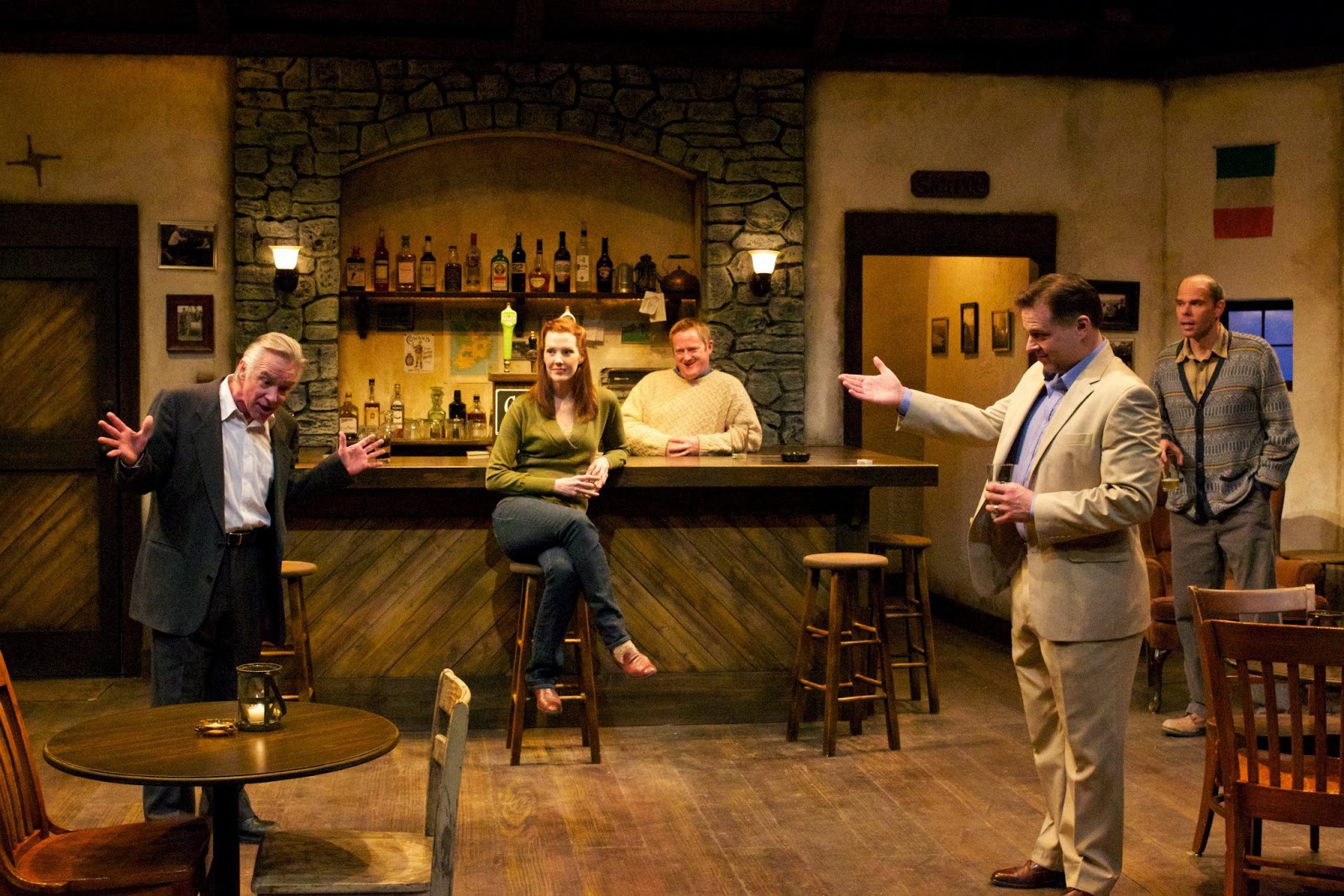
Jonathan Wentz has created a marvelous Irish pub set, complete with working draft beer.  It's a warm, inviting environment for the characters on a windy, cold night.  Wentz paid very careful attention to the details of his set.  The photos on the wall are precisely as described in the script.  The liquor bottles behind the bar are precisely what you would expect to see.  The working tap delivers cold beer to the characters.  It is, in fact, not a set as much as a real working Irish pub on the Theatreworks stage.
Left to Right:  Michael Augenstein (Jack), Mandy Olsen (Valerie), Andy Sturt (Brendan),
Joseph Discher (Finbar), & Patrick Toon (Jim).
The ensemble cast is talented, and their Irish accents are very credible.  The program, unfortunately, does not list a dialect coach.  Someone really should get credit for getting the accents right.  Michael Augenstein (Jack) is the onstage ringleader, and his Irish brogue is always accompanied by a beer or a "small one" (a "small" whiskey shot in a large water glass) and flailing arm gestures.  His lovable bluster drives the discussions for the entire performance.
The beer and whiskey appeared real; the actors drank throughout the 100 minute performance.  Frankly, I don't know if I could have done as well under those circumstances; I would have been slurring words, and probably not the same ones found in the script.  These guys/gal are pros.  Not a slurred word, not a tipsy one in the bunch.  Of course, it's always possible that they didn't really consume copious amounts of alcohol onstage...they ARE actors, after all.
As a person with some Irish heritage, I was fascinated by the graceful humanity of the Irish as portrayed in The Weir.  However, I was also somewhat concerned that the same portrayal reinforced some conventional Irish stereotypes.  I haven't spent much time in Irish pubs, so perhaps those conventional stereotypes are more accurate than I realize.
Jerry Seinfeld made a career with a show about nothing; it ran on television for more than nine years.  The Weir just may have as much success as Seinfeld.  The characters are entertaining, and the stories are poignant.  The play debuted in 1997, and is still being produced 17 years later.  It's not Seinfeld, but it certainly is an engaging evening of theater.  
"Not that there's anything wrong with that."
Mandy Olsen, Andy Sturt, Michael Augenstein.  At the bar.

NOTES:  
This show closes on February 9, 2014.  
No children under 5 years old will be admitted, and the company does not recommended The Weir for children under 13.  However, the subject matter may be of limited interest for many teens.  This show is especially recommended for those of Irish heritage.  There is vulgar language.
Arrive early enough to read the program before the performance.  In addition to the explanation of the "weir," there is also a handy list of Irish vocabulary terms used in the play.  The list is helpful for a better understanding of the dialog.
Pre or post show dining suggestionJack Quinn's Irish Alehouse & Pub, 21 S. Tejon Street, Colorado Springs CO.  It's not exactly close to the theater (allow at least 15 minutes for the drive to or from the theater in good weather), but you will not find a better, more authentic Irish pub anywhere, except perhaps Ireland.  Whether you're looking for Shepherds Pie, Bangers & Mash, Irish Stew, or Corned Beef & Cabbage, Jack Quinn's is the place. Draft beers include Guinness, Harp, Smithwick's, & Kilkenny.  By my count, they have over 20 Irish whiskeys.  What could possibly go wrong?
Photo Credits: Theatreworks.

Director:  Joseph Discher
Set Design:  Jonathan Wentz
Lighting Design:  Matthew Adelson
Sound Design:  Alex Ruhlin
Costume Design:  Jan Avramov

Cast:
Brendan:  Andy Sturt
Finbar:  Joseph Discher
Jack:  Michael Augenstein
Jim:  Patrick Toon

Valerie:  Mandy Olsen

Saturday, February 1, 2014

Annapurna

Playwright:  Sharr White
Venue:  Carsen Theatre, The Dairy Center for the Arts,   2590 Walnut Street, Boulder CO 80302.
Running Time:  1 hours, 38 minutes (no intermission)
Date of Performance:  Thursday, January 30, 2014 (Preview performance)

You may wonder about the title.  Who or what is an Annapurna?  
Annapurna is a Himalayan mountain in Nepal.  It was the first peak over 8,000 meters high to be summited.  Frenchman Maurice Herzog led the 1950 climbing expedition, and recounted the entire experience in his book "Annapurna."  Herzog's tremendous accomplishment, and his literary narrative, slowly devolved into a mountain of controversy that ultimately questioned whether they even made the summit.
Herzog's memories may have been clouded by ego, exhaustion, lack of oxygen, and enough frostbite to cost him nearly all his fingers and toes.  Sharr White's Annapurna script uses the fragility of memories to tell a story that is alternately shocking and endearing.
Ulysses (Chris Kendall) has degenerated from successful poet to a hermit living in a small trailer.  He's in poor and failing health, living in filth.  He likes the ants in the kitchen better than the roaches.  Although his situation seems desperate, Ulysses seems content, no, pleased with his lifestyle choices.  And much like Maurice Herzog, his memories of how he got to this point in his life are faded, or in some cases, completely gone.
Ulysses' ebbing life is upended as the show opens; his former wife Emma (Kate Gleason) shows up unannounced 20 years after their divorce.  She quickly gives up her "just passing through" ruse to pursue her real reason for abruptly appearing after two decades.  Their son is coming to the trailer park to find his father, and she wants some answers about the events that caused the divorce.
You'll have to buy a ticket to hear the rest of the story, and I highly recommend that you do just that.  Annapurna is a deep, thoughtful journey to a dark place most of us are familiar with:  failed relationships and the two entirely different and contradictory memories of the same events.  If you've ever left someone, or had someone leave you, Annapurna will take you back to your own failed relationships and the questionable memories you may still harbor.
Annapurna forced me to confront and question my own memories.  I have always known on some level that there are two versions of that breakup; now I have to wonder whether either version is accurate.  It's a rare and wonderful play that helps us know ourselves better.  Annapurna is one of those rare and wonderful plays.
Director Rebecca Remaly has a talented cast, and she makes the most of those talents.  Her Ulysses is a delicate mix of creepy and lovable.  Remaly's Emma is both victim and provocateur.  Remaly keeps both finely balanced between the extremes they are capable of.  She has carefully blocked the nudity to show us Ulysses with both crudeness and dignity.
Kate Gleason (Emma) and Chris Kendall (Ulysses)
Chris Kendall seems to have walked onto the set from a real trailer park.  He's unshaven, brazen, and proud to be a refugee from civilization.  A veteran of all of life's vices, Kendall is a lovable Ulysses despite his persistent contempt for social conventions.  It's no small feat to be convincingly lovable with so many flaws, but Kendall is perfect in his role.
Kate Gleason does what few actors can do; she cries real tears on cue.  Her performance is stunning.  She literally spills a box of Ulysses' memories all over the floor.  All of his significant memories of the last two decades crash and scatter like the dwindling ripples on a pond.  The effect is arresting; his fragile memories (and ours by extension) can never be put together again in any meaningful way.  Gleason owns that definitive moment on the stage.
Annapurna ends on a hopeful note; reconciling our memory lapses isn't as important as reconciling our relationships.  That's a substantial message to take away from Annapurna.  
This is, indeed, a wonderful story, wonderfully told.  In the final analysis, life is best defined as finite amount of time with those we know and love.  It's a message that we need to hear more often...and heed more often.

NOTES:  
This show closes on February 16, 2014.  
This show is recommended for adults and mature teens.  There is adult language and brief nudity.
There is a Colorado connection for Annapurna; playwright Sharr White graduated from Fairview High School in Boulder.  (Happy coincidence and disclaimer.  My grandson Niko Wheeler goes to school there.)  Annapurna is set in Paonia Colorado.  

This Boulder Ensemble Theatre Company (BETC) production is a regional premiere.  BETC has also produced White's play The Other Place in 2013.
Pre or post show dining suggestion:  Golden Lotus, 1964 28th Street, Boulder CO.  It's very close to the theater, has an extensive menu, and the servings are large.  If you like Chinese food, Golden Lotus is a Boulder tradition you must try.

Director:  Rebecca Remaly
Set & Lighting Design:  Ron Mueller
Sound Design:  Daniel Horney
Costume Design:  Brenda King

Cast:
Emma:  Kate Gleason

Ulysses:  Chris Kendall