Pages

Tuesday, October 6, 2015

Silent Salzburg


Playwright: Richard Medugno


Venue:  Funky Little Theater, 2109 Templeton Gap Road, Colorado Springs, CO.

Running Time:  2 hours, 20 minutes (includes 15 minute intermission).

Date of Performance:  Sunday, October 4, 2015. 

In my somewhat limited experience, it’s not common knowledge that deaf people were targeted by the Nazi’s when they came to power.  I knew Jews were targeted.  I knew homosexuals were targeted.  That disabled people, including the deaf, were targeted as well was, well, news to me.

Mass sterilization of deaf people began in 1933, as soon as Nazis came into power; approximately 17,000 were forcibly sterilized.  More than 70,000 disabled or otherwise “incurably sick” individuals were treated with a “mercy death” in the Action T4 program, part of the Nazi euthanasia effort to purify the Germanic race.

Silent Salzburg, while not a true story, is a historically accurate one.  In Nazi Germany, deaf people, and other disabled individuals, were sterilized or exterminated.  Playwright Richard Medugno sets his story in a small Austrian town in the spring of 1940, and in the Klottmeier home.  Stephana (Janette O’Brien) and Gerhardt (Shawn Harmer) have a daughter Lisa (Kate Noonan Rickers) and a son Hans (Albert Tharpe III).  Hans is a deaf teen, and the Nazis are looking for him.

It’s a chaotic development.  Hans has just met and fallen in love with a girl (Marlena, played by Liesel Viser).  Gerhardt has a business, and is reluctant to flee the Nazis.  Stephana is terrified; she can’t abide the thought of Hans never being able to have his own children.  

Despite Gerhardt’s foot dragging, Stephana convinces him to take up her plan:  flee to Salzburg and stay with her brother Otto until they can contact cousins in Switzerland and move there.  That, in a nutshell, is the story arc for Silent Salzburg, and it is a compelling drama from the outset.

Director Nicki Runge has provided the audience with ample interpretation.  “Shadow Interpreters” follow the speaking actors onstage, translating their words into signs.  Albert Tharpe III, as Hans, has no lines.  He only signs.  His thoughts are voiced mostly by his stage sister, by Kate Noonan Rickers, who is bilingual in spoken English and American Sign Language (ASL).  Noonan’s interpretation is completely consistent with the script, as Hans’ parents do not know ASL.  She interprets for them, and for the audience.  For those who wondered how a deaf theater experience is possible, fear not.  It’s not just possible.  It’s enhanced by the nuances of both spoken English and ASL.

The story continues at uncle Otto’s place in Salzburg, and as one might expect, there are some bleak developments as the Klottmeiers try to wait out the Nazis.  It gets very dramatic, and there are some tears shed in the audience as the story unfolds.  

Think about that.  Everyone in the audience, whether hearing or deaf, needs help to understand the script.  Everyone has to pay careful attention to the words and/or the signs.  Yet the story is universal, so dramatic, and so moving that hearing and deaf alike are overcome by the emotional heartbreak of Silent Salzburg.  Not many productions can close such a large communications gap and bring the very different parts of the audience to the same emotional climax.  Silent Salzburg succeeds at something few would even try.
Front:  Albert Tharpe III, Kate Noonan.  Back:  Janette & Dan O'Brien.

Of course, the cast gets a lot of the credit for making Silent Salzburg work.  Kate Noonan Rickers sparkles as Lisa, and helps both the hearing and the deaf make sense of the script.  Noonan has a compelling stage presence, and she uses it to her advantage.  Albert Tharpe III has done some acting before, and it shows.  His signs are clear, his emotions are genuine, and his delivery is spot on.  I credit Tharpe for introducing me to my first two jokes done in ASL.  Noonan translates them, but Tharpe delivers them with wit and a wink.

Hans’ stage parents, Shawn Harmer and Jannette O’Brien, are convincing, both when they are protecting Hans and when they are fighting over how to do that right.  Harmer’s best moments are when he has to confess some long forgotten sins.  O’Brien stands out when she puts her foot down and fights for Hans.  That said, though, what really struck me about Harmer and O’Brien was how well they portrayed one of the serious issues for parents of deaf children.  That issue is whether parents should learn to sign.  Neither Stephana nor Gerhardt can sign.  The question of parents signing plays out beautifully here, and therein lies some of the message for the audience.

Dan O’Brien plays uncle Otto, and he’s exactly the right type for the role.  He’s a bachelor, lives alone, and for those reasons alone, he is also one who might fear the Nazis.  O’Brien seems totally natural as he generously takes in his family for an extended stay.
Lisel Viser (Marlena).

Liesel Viser (Marlena) is Hans’ girl friend, and we can all understand immediately why he fell in love with her.  She’s beautiful, she’s smart, and she’s the kind of girl we all want for our sons.  It’s a fairly small but critical role, and Viser makes the most of it.

I don’t want to spoil the surprise, but Director Nicki Runge puts her own spin on Silent Salzburg.  She goes to the trouble to make sure the audience understands how difficult it is to communicate when we’re not all speaking the same language.  She makes her point, but to say more would spoil it for others.  Let’s just say that Runge does exactly what a director should do:  she put her own mark on this production.

Rachel Rose, Courtney Williams, and Shayne Montoya do yeoman’s duty, doubling as “Shadow Interpreters” and stage hands.  They made the show work by interpreting the spoken lines to ASL, and they did it onstage, in front of everyone, while making appropriate facial expression with their signs.  I didn’t understand the signs, but I couldn’t help but watch them.  It’s hard work, it has to be precise, and the timing is critical.  They were splendid.

The Silent Salzburg cast and crew is hitting the road for Fort Collins and Denver.  If you’re in either of those areas, check it out.  It’s a very special and rewarding theater experience, steeped in dark history, and played out in devastating emotional crises.  That’s a recipe for a fine evening at the theater.
Front:  Kate Noonan, Albert Tharpe III, Liesel Viser.  Back:  Shawn Harmer, Janette O'Brien, Dan O'Brien, Shadow Interpreters Rachel Rose, Courtney Williams, Shayne Montoya.

NOTES:

This show closes on October 11, 2015 at the Funky Little Theatre in Colorado Springs.  Silent Salzburg will move to Fort Collins at the Bas Bleu Theatre October 15 (School performance only) and October 16, 17, and 18.  There will also be performances on October 25 and 27 (school performance only) in Denver at The Bug Theater.


TICKETS HERE:  


CREATIVE TEAM:

Director:  Nicki Runge

Scenic Design:  Kevin Souhrada

ASL Coach:  Rachel Blythe

CAST:

Stephana Klottmeier:  Janette O’Brien

Lisa Klottmeier:  Kate Noonan Rickers

Gerhardt Klottmeier:  Shawn Harmer

Hans Klottmeier:  Albert Tharpe III

Marlena:  LIesel Viser

Uncle Otto:  Dan O’Brien

Shadow Interpreters:  Rachel Rose, Courtney Williams, Shayne Montoya


Monday, October 5, 2015

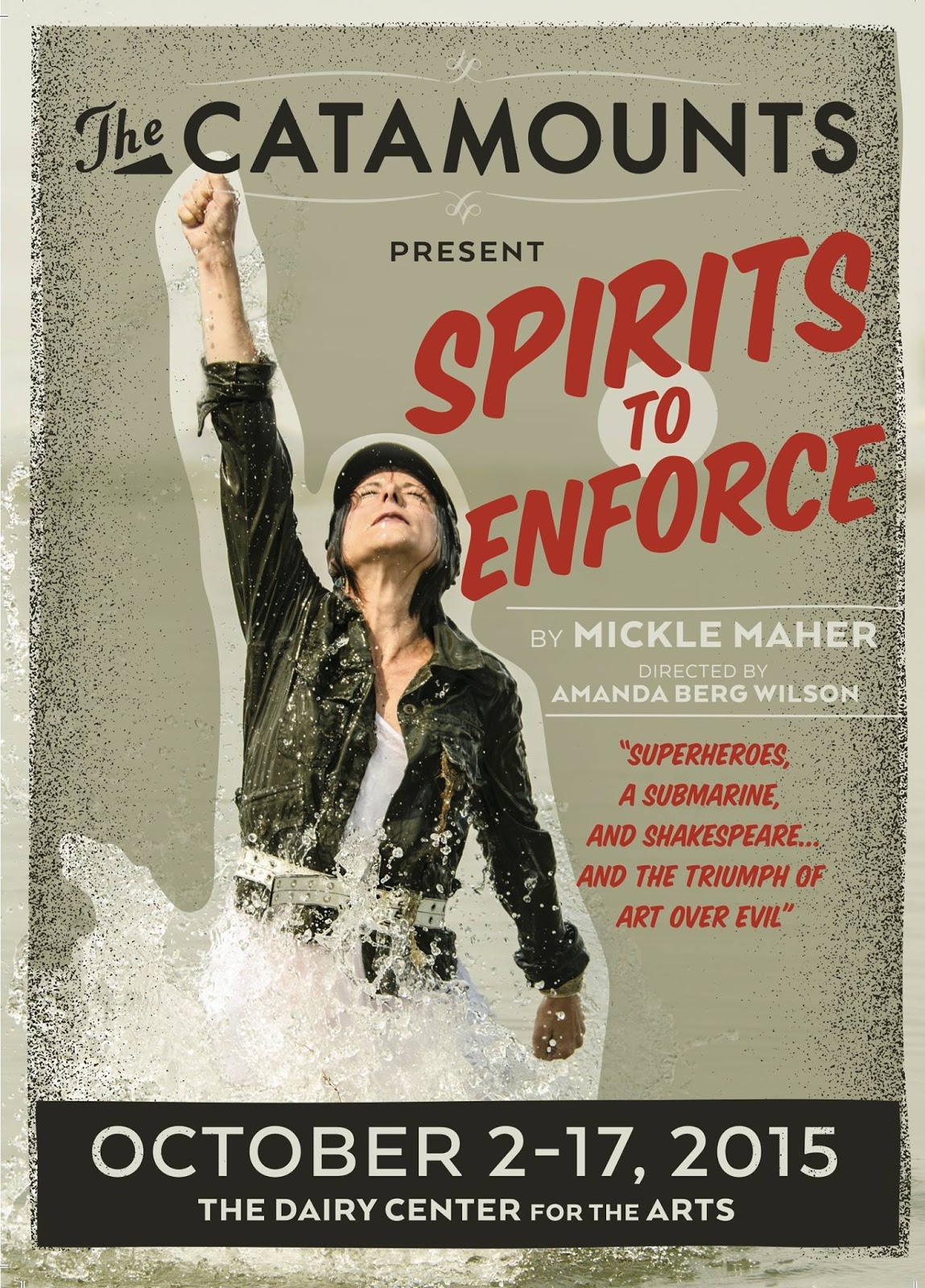
Spirits to Enforce: “Superheroes, A Submarine, and Shakespeare… and the Triumph of Art Over Evil.”


Playwright: Mickle Maher

Inspired by and incorporating parts of:  The Tempest by William Shakespeare

Company:  The Catamounts

Venue:  East Theatre, Dairy Center for the Arts, 2590 Walnut Street, Boulder, CO.

Running Time:  1 hour, 20 minutes (no intermission).

Date of Performance:  Saturday, October 3, 2015. 


“Now I want
Spirits to enforce, art to enchant,
And my ending is despair,
Unless I be relieved by prayer,
Which pierces so that it assaults
Mercy itself and frees all faults.
As you from crimes would pardoned be,
Let your indulgence set me free.”

William Shakespeare, The Tempest, Act 5, Epilogue

For those wondering what the title Spirits to Enforce is all about, there you have it.  The Tempest, Act 5, Epilogue.  What you can expect at The Catamounts’ production of Mickle Maher’s script is some spirits and some art, to enforce and enchant.  What you need not expect is despair.  The focus will be comedy and a LOT of inside jokes about the theater “industry.”  

Maher’s script is nearly indescribable, but here’s my inadequate attempt to do just that.  The cast of twelve is working the phones at a telemarketing “boiler room” located not actually in a boiler room, but in a submerged submarine.  They are marketing a production of The Tempest to a totally detached and disinterested public.  
Spirits to Enforce:  submerged telemarketing Boiler Room.

Each cast member is playing three simultaneous roles.  The first is a regular guy or gal, the second is a superhero, and the third is a character in The Tempest.  It’s not as confusing as it sounds; think of them as regular guys and gals first.  Just as Clark Kent is also Superman, Bruce Wayne is also Batman and Peter Parker is also Spiderman, these are real people first, and superheroes second.

You may wonder how superheroes end up in such a dreadful occupation as telemarketing.  It’s a good question. (Actors, directors, and other theater types can insert your own dreadful day jobs here.  Your superpowers probably don’t pay the bills either.)  

L-R:  Joan Bruemmer-Holden, Merideth C. Grundei, Trina Magness, Verl Hite.
The answer is that they are better described as “semi-super” heroes, and thus relegated to begging for money.  Spirits to Enforce superpowers include “The Silhouette” (played by Elgin Kelly), who is the master of shadow puppets, the “Fragrance Fellow” (played by Stephan Geering), who can detect a wide variety of scents, and “The Untangler" (played by Verl Hite), who can untie difficult knots.  From this I think it proper to assume that 1) superpowers may be more common than we expected, and 2) perhaps we all have some “superpower.” 

L-R: Stephen Geering, Jason Maxell, Laura Lounge, Joan Bruemmer-Holden
To say the show opens with chaotic cacophony may be an understatement.  The 12 characters/superheroes/actors babble interminably on their phones, challenging the audience at the outset to make sense of the chatter.  Director Amanda Berg Wilson slowly begins to alternate the chaos with decipherable dialog, lighting one or two of the characters at a time and silencing the 10-11 others.  We learn that rehearsals start on Sunday.  Or Saturday.  Or they have already started and are going very well.  It seems that telemarketers everywhere take liberties with the facts.

In the process of begging for donations to The Tempest production, we are treated to an array of theater humor:

“The main part of the word “rehearse” is hearse…a vehicle to convey the dead.”

“If intoxication has any place, it is in rehearsal.”

For those involved in any manner with theater production, Spirits to Enforce is a must see show.    It’s a profoundly funny parody of the process.  If some of the inside jokes fall flat for the rest of us, that doesn’t diminish the folly of the argument that rehearsals spend way too much time on the script.  All of us can get that joke.

There is one particularly profound and striking point in the show where the entire cast goes silent.  The lights focus on the twelve exhausted and disappointed characters in a scene reminiscent of DaVinci’s Last Supper.  I may be reading too much into the staging, but the scene struck me as a brilliant and beautiful parody of the painting.  Perhaps the staging here is to subtly suggest the potential disaster for The Tempest?


The cast is exemplary; they define themselves magnificently as distinct characters in what is a decidedly difficult environment.  Merideth C. Grundei (Evelyn Lawson/Ariel) keeps the somewhat unruly group under some control, even if she has to stand on the table to do it.  Joe Von Bokern (Randall James/The Tune/Ferdinand) lacks self-confidence, but tries to hook up with Susan Tanner/Memory Lass/Miranda (Laura Lounge), who doesn’t even know who he really is.  Dale Clark/The Intoxicator/Stephano (Trina Magness) gets some of the biggest laughs in the show as she deals with her intoxicants and the consequences.  Each and every cast member here turns in a remarkably fine performance in a setting that makes it seem impossible to stand out.

The larger themes here (Do we all have our own superpowers? Does art really triumph over evil?) are less clearly drawn than the theater parody.  Without revealing too much plot information, I will say that it is a difficult question whether one might prefer performing to an empty auditorium to one filled with one’s mortal enemies.  Spirits to Enforce asks that question, and then answers it.  For those who have faced both empty seats and hostile audiences (hopefully not at the same performance), I’m sure you will have your own answers.  

That The Catamounts are unafraid of risk is obvious; Spirits to Enforce is ample proof.  This show experiments with both style and substance.  It challenges the audience from start to finish.  For those who want the convenience and comfort of traditional theater fare, this show may not be for you.  For those of us who value innovation, experimentation, and challenge, Spirits to Enforce is a veritable feast for the eyes, the ears, and especially for the mind.  

The Catamounts have a motto:  "Theater for the Adventurous Palate."  Spirits to Enforce is a delicious entree for that adventurous palate.

NOTES:

Free parking is available behind The Dairy Center and on surrounding streets.  There is construction going on at The Dairy, as they renovate the property.  The temporary main entrance is on the west (back) side of the building.  After entering, go down the long hall…the box office will be on your left. 

Boulder Ensemble’s Outside Mullingar is playing in the Carsen Theater, immediately adjacent to the East Theater.  Please be courteous and limit any unnecessary noise that could disrupt the neighboring production.

If you are concerned that you have never (or maybe not for a long time) seen The Tempest, fear not.  A detailed understanding of Shakespeare is not needed to enjoy Spirits to Enforce.

This show closes on October 18, 2015.

PHOTO CREDITS:  The Catamounts

TICKETS HERE:  

CREATIVE TEAM:

Director:  Amanda Berg Wilson

Lighting Design: Ryan Wentworth 

Scenic Design/Technical Direction:  M. Curtis Grittner

Costume Design:  Annabel Reader

Stage Manager: Ashely Beach

CAST:

Rebecca Lloyd/The Ocean/Gonzalo:  Rebecca Brown Adelman

Cecily Grey/The Page/Prospero:  Joan Bruemmer-Holden

Oliver Kendall/Fragrance Fellow/Sebastian:  Stephen Geering

Emory Lawson/Ariel:  Meridith C. Grundei

Diana Blake/The Bad Map/Trinculo:  Susan Harrison

Brad Allen/The Snow Heavy Branch/Alonso:  Ben Hilzer

Wayne Simon/The Untangler/Caliban:  Verl Hite

Donna Adams/The Silhouette/All Masque Characters:  Elgin Kelley

Susan Tanner/Memory Lass/Miranda:  Laura Lounge

Dale Clark/The Intoxicator/Stephano:  Trina Magness

Craig Cale/The Pleaser/Antonia:  Jason Maxwell

Randell James/The Tune/Ferdinand:  Joe Von Bokern

Spirits to Enforce original theme written and performed by Joe Von Bokern


Sunday, October 4, 2015

My Name Is Asher Lev


Playwright: Aaron Posner

Adapted from the novel by Chaim Potok


Venue:  Miner’s Alley Playhouse, 1224 Washington Avenue, Golden, CO.

Running Time:  1 hour, 35 minutes (no intermission).

Date of Performance:  Friday, October 2, 2015. 


Here’s a question to ponder as you read this review:  

What do you call someone who, when faced with a dilemma, will tell a seemingly harmless lie to avoid hurting someone?  

It’s a situation we have all faced; often we satisfy another with some small dishonesty instead of hurting that person with the truth.  Chaim Potok’s answer can be found below, at the end of this review.

I have not read Potok’s 1972 novel My Name Is Asher Lev.  After seeing Aaron Posner’s 2009 stage adaptation at Miner’s Alley Playhouse, I’m putting the novel on my “must read” list.  Potok’s novel (and Posner’s adaptation) is a deep, densely packed story of religion, family, tradition, suffering, art, and human values.  That’s not a full plate; it's an overflowing and spilling all over the floor plate.  It’s a very ambitious story, but the telling of it is so compelling, so engaging, and so personal that the Miner’s Alley Playhouse production seems to fly by in the blink of an eye.  

Curtiss Johns (Asher Lev).
Set in a Jewish community in Brooklyn in the 1950s, My Name Is Asher Lev is a story of conflicting values.  Asher Lev (played here by Curtiss Johns) has a "gift."  Even as a young boy, he had a talent for drawing, sketching, and painting.  Early on, his gift became an obsession.  He did not paint because he wanted to.  He painted because he had to.

The conflict arises because Asher Lev is an observant Jew, and when he begins to sketch nudes and crucifixions, his parents (Albert Banker plays his father and other male roles as Jacqueline Garcia plays his mother and other female roles) are aghast.  Asher could have chosen less deplorable subjects than the symbol of Christian suffering and naked bodies, but he was driven by his “gift.”  As he explained to his parents, the nudes are part of the tradition of art.  Mastering the form of the human body is an artistic prerequisite for any competent artist.  As for the crucifixions, all the great Christian artists painted Christ on the cross; Asher Lev could do no less.

The conflicts are many in My Name Is Asher Lev, and therein lies the power of the story.  Asher Lev cannot reconcile his religion with his art; nor can he reconcile his art with his parents’ values.  Despite good advice that he must choose between art and religion, he refuses.  He remains an observant Jew and yet becomes a respected artist. 

Posner brings Potok’s conflicts to the stage with compelling dramatic effect, benefitting greatly from the striking beauty of Potok’s language. Director Len Matheo provides the cast with blank sheets of paper and a blank canvas and lets Potok create the images with his words. That's remarkable; this is a story about art that does not show us actual art. Using only Potok’s vivid descriptions, the audience can virtually see the beauty and the power of Asher’s Lev’s work.  

Matheo’s touch is a tender one.  He keeps Asher Lev’s parents dignified and lovable despite their revulsion with their son.  He delicately stages Asher Lev painting a model; Matheo somehow cloaks her nudity with a Jewish sense of modesty.  Despite the deep divisions and the sharp conflicts in the script, Matheo keeps the tone civil and respectful.  There is no villain on Matheo's stage, only victims.

When he was interning with artist Jacob Khan, Asher Lev was advised that he must focus solely on his art, to the exclusion of everything else, to become a successful artist.  Curtiss Johns has apparently internalized that advice, as he creates a dynamic, conflicted, and compelling Asher on the Miner’s Alley Playhouse stage.  Johns is in complete command of Asher the artist, Asher the boy, Asher the son, and Asher the complex human being.  It is a striking performance, one only possible for an artist who is focused on nothing but his art.  From the time he takes the stage in the opening scene until he closes the show, Johns is spellbinding as the boy, the man, and the artist that Potok created for him on paper.

Albert Banker (Aryeh and The Men).
Albert Banker plays the male roles, including Asher Lev’s father Aryeh, and he does it with the zeal of a devoted father.  Banker is most convincing when he is at his most perplexed; he just cannot understand why his son Asher Lev must paint.  Banker conveys his disbelief not just with words, but with gestures and facial expressions that would disarm any skeptic.  Jacqueline Garcia has the female roles, including Asher Lev’s pensive, distraught and grieving mother Rivkeh.  Garcia plays Rivkeh as a classic Jewish mother, doting on Asher Lev but always inserting her values into her mothering.  Garcia, however, is not just Asher Lev's mother. She is also the grieving sister whose brother gave his life for his religion. Garcia's suffering is conspicuous and convincing; our empathy for Rivkeh is off the charts.

Nicole M. Harrison’s costumes are spot on; each character has the distinct look of both the period and the Jewish culture.  Using a few small items such as a scarf or a shawl, she changes the characters in seconds from a mother or a father to a model or a rebbe (not a rabbi, but the leader of a Hasidic sect).  Jonathan Scott-McKean’s set design is simple but functional, and includes a projection screen.  The projections effectively set the tone and the context at times, but more projections could have improved the story telling.  There were fairly long periods of blank whiteness between projections.
Jacqueline Garcia (Rivkeh and The Women).

My Name Is Asher Lev is a beautifully written, piercing look at the intersection of religion and art. That intersection is littered with the shattered values that collided there. The Miner’s Alley Playhouse production set out to “get it right.” They do. They have scattered Potok's emotional debris all over their stage. This is one of those theater experiences that you won’t soon forget.  

It’s time to answer the question I asked at the outset:  what do we call someone who would compromise his or her values to satisfy another?  Chaim Potok and Aaron Posner say that person is a WHORE.  Your answer may differ, but the point is clear.  If you would trade your integrity to please your family or a friend, your moral ground may be quicksand rather than concrete.  Art cannot be built on quicksand; nor can life.

Asher Lev is not a whore.  He refuses to surrender his values to please anyone.  Nor are there any “whores” in this production.  There are only capable, talented artists who have created a poignant gem of a show by telling a difficult truth:  a great artist must be painfully honest, and he or she must accept the consequences of that honesty.

NOTES:

Free parking is available behind Miner’s Alley Playhouse and on surrounding streets. 

There is brief partial nudity, but I doubt very much that anyone would be offended by it.  In fact, I would say that this show is suitable for children.  However, younger children unfamiliar with the Jewish faith and culture may not be able to follow some of the references very well.  Further, the themes (I’m speculating here) may not interest children under the age of 12.

The program includes two pages of “Asher Lev Lexicon.”  It explains some of the Yiddish terms used in the script.  For those unfamiliar with Yiddish terms, it is a very helpful read before the show starts.

You may be wondering whether My Name Is Asher Lev is a show that would work best for Jewish audiences. Let me assure you that while Jewish audiences will find much to like here, the story is as human and the themes as universal as any you will ever encounter.  My Name Is Asher Lev is a provocative theater experience for everyone, whatever your religion or ethnicity.  

This show closes on October 18, 2015.

PHOTO CREDITS:  Miner’s Alley Playhouse and Sarah Roshan

TICKETS HERE:  


PRE/POST SHOW DINING RECOMMENDATION:

We were running late.  In a last minute attempt to find something to eat before the curtain went up, we spent 10 minutes or so at Jimmy John’s at 1299 Washington Avenue.  It’s a 2 minute walk to or from the theater, and as they say, it’s “freaky fast.”  It’s definitely not gourmet food, but basic subs made with quality ingredients.  I had low expectations which were totally exceeded.  Tasty, quick, and inexpensive.  In a rush, I’d go there again.

CREATIVE TEAM:

Director:  Len Matheo

Lighting Design: Vance McKenzie

Sound Design:  Len Matheo

Scenic Design/Projection Design:  Jonathan Scott-McKean

Costume Design:  Nicole M. Harrison

Stage Manager: Bryanna Scott


CAST:

Asher Lev:  Curtiss Johns

The Men:  Albert Banker

The Women:  Jacqueline Garcia


Saturday, September 26, 2015

The 39 Steps


Adapted by:  Patrick Barlow

Adapted from:  The 39 Steps (novel, 1915) by John Buchan and The 39 Steps (film, 1935) by Alfred Hitchcock.


Running Time: 1 hour, 45 minutes (includes 15 minute intermission).

Date of Performance:  Tuesday, September 22, 2015. 

The 39 Steps is a popular show in Colorado this season; I believe there are or have been at least three Colorado productions recently.  It’s a show that I hadn’t seen before, but now that I have, I understand why it’s a popular script.  It first opened in London in 2005, and just closed a few weeks ago after a nine year run (making it the 5th longest running show in West End history).  It was nominated for 6 Tony Awards when it opened on Broadway in 2008, and won two (Best Lighting Design and Best Sound Design).

This is a fast paced comedy/parody of the 100 year old source material (John Buchan’s 1915 novel and Alfred Hitchcock’s 1935 film).  It plays out as a melodrama, with nods to Hitchcock’s classics (“use the Rear Window,” “which way did he go?  North by Northwest”).  (Quotations are approximations.)  

For those who have neither read Buchan’s novel nor seen Hitchcock’s film, the “39 Steps” is a veiled reference to a German spy network, although there is little explanation in the script.  The clandestine operation accounts for a great deal of onstage mayhem, beginning with a murder in Richard Hannay’s (Chris Onken) apartment.  The victim, Annabella Schmidt (Rebecca Myers) is splayed out on Hannay’s lap with a knife in her back.  Thus begins Hannay’s flight and fight, as he is wanted for a murder he did not commit.
Rebecca Myers (Annabella and others).

Rebecca Myers’ demise early in the show is not the end of her story.  She is reincarnated for several other characters, using an array of wigs and some exquisite costumes.  Myers is surprisingly malleable, making each character she plays completely distinct from the others.  With each costume change and new incarnation, she is the company chameleon.  

There are roles for two clowns here, and both actors are well cast for the clowning. Levi Penley (Clown 1) is a strapping guy who often ends up in drag.  Surprisingly, he is quite fetching as a woman.  He adjusts quickly to his feminine roles,  speaking in a softer, higher voice to make the illusion seem real.  Penley cuts up as a clown must, getting some of the biggest laughs in the show.

Nick Madson is the other clown (Clown 2), and he is also an excellent choice for Director Ed Weathers.  Madson is also adept at changing roles and costumes in a blink of an eye, moving seamlessly from one character to the next.  Madson and Penley share the stage for one of the most hilarious moments in the show, as the pair chase Hannay through a train.  When Hannay ducks out of the car and clings to the side of the train, Madson and Penley follow him.  The pair puts on a fantastic pantomime of a high speed train chase while hanging on for dear life.  For me, it was the high point in the entire show.
Nick Madson (Clown 2 and others).

Chris Onken has the central role as Hannay, and he has the luxury of playing a single character in a play where the other actors must portray multiple personalities.  Still, the challenge for Onken is substantial.  He’s onstage for the entire performance, evading the authorities at every turn.  Onken has to navigate multiple crises, maximizing the dramatic tension each time.  He gets shot, but survives due to a stroke of incredible luck.  Onken manages to maximize audience empathy while pushing the limits of credibility.
Chris Onken (Hannay).

Ed Weather’s direction is imaginative and frenetic; the action is non-stop.  He has a talented cast and he puts them through a crazy endurance test of costume and character changes.  To his directing credit, they have responded admirably.

All of which is to say that The 39 Steps at the Butte Theatre is great fun.  The characters are zany, the actors are lovable, and the script is full of surprises.  If you’re not laughing, you may not have a pulse.  

The 39 Steps might just be the vehicle to revive melodrama as a genre.  It’s not just about a villain with a mustache tying the heroine to the train tracks.  Melodrama evokes strong characters, strong emotions, and often a triumph of good over evil.  Those are valuable qualities, but perhaps the best argument for reviving melodrama is its very high fun quotient.  The 39 Steps is ample proof of the fun one can have at a melodrama.

Before closing my comments on The 39 Steps, I must mention the venue:  The Butte Theatre, and formerly, the local Opera House.  It opened as the Butte Concert and Beer Hall in 1896.  Over the years, it has had several incarnations: the Butte Hall Dancing Academy, followed by The Watt Brothers Furniture Company, back to a theater, then into a skating rink, a secondhand store, a weapons cache (The Armory) and an auto garage.

Today it stands as a beautifully restored jewel of the high country, a state of the art theater with 185 seats and a resident theater company (Thin Air Theatre Company) since 2007.  With hardwood floors, period furnishings, comfortable seats, and nearly a 120 year history, the theater is a very special venue.  

If you haven’t had a chance to see a show at The Butte, check it out.  It's well worth a trip to Cripple Creek.  Take your slot machine or blackjack winnings for walk to 139 E. Bennett Avenue.  It’s just steps from the casinos, but it’s a whole other world.  

NOTES:

I hadn’t been to Cripple Creek for some years.  I’m happy to say that I broke even on this trip, but that would be because I didn’t have time to sit down at a blackjack table.  Next time.

Cripple Creek is approximately one hour from Colorado Springs, and about two hours from Denver.  It's one of the reasons we live in Colorado.  It's a historic mountain mining town, and a wonderful three season mountain drive.  It's one of only three gaming towns in Colorado (the other two being Central City and Blackhawk), but it offers much more than slot machines.  If you haven't been there lately, check out Thin Air Theatre Company and the Butte.  You'll enjoy the show, and you might even take some extra cash home with you.

Free parking is available on surrounding streets and in various casino parking lots.  

This show closes on September 26, 2015.

PHOTO CREDITS:  Thin Air Theatre Company

TICKETS HERE:  

PRE/POST SHOW DINING RECOMMENDATION:

There are numerous gambling and dining choices in Cripple Creek.  Thin Air Theatre Company has generously provided a list of dining options on its web page.  We stopped at McGill’s Pint & Platter.  I don’t recommend it, as the food was below average.

CREATIVE TEAM:

Producers:  Chris Armbrister & Mickey Burdick

Director: Ed Weathers

Set/Lighting Design: Mickey Burdick

Assistant Technical Director:  JT Rider

Costume Design:  Nancy Hankin

Stage Manager: Tom Mosher


CAST:

Richard Hannay:  Chris Onken

Annabella Schmidt:  Rebecca Myers

Clown 1:  Levi Penley

Clown 2:  Nick Madson