Pages

Tuesday, June 23, 2015

Lucky Guy

Playwright:  Nora Ephron


Venue:  The Edge Theater, 1560 Teller Street, Lakewood, CO.

Running Time: 2 hours, 15 minutes (includes 15 minute intermission). 

Date of Performance:  Sunday, June 21, 2015. 

Mike McAlary was a real guy, and he was the “lucky guy” of the title.  He got his career dream job as a columnist for several New York City newspapers.  McAlary’s story is truly one of those “be careful what you ask for” tales; being lucky doesn’t always translate into being happy.

Nora Ephron, whose film credits include When Harry Met Sally and Sleepless in Seattle, wrote this script, telling the true story of how a sportswriter became the voice of New York tabloids for more than a decade.  Lucky Guy was nominated for six Tony Awards 2013, and won in two of those categories (Best Featured Actor, Best Lighting).  Lucky Guy was Ephron’s final work; she died about a year before it opened on Broadway.

The story of Mike McAlary’s career covers his early years, working the police beat and socializing nightly with the other news guys at various Irish taverns.  Ephron has given McAlary (Andrew Uhlenhopp) a couple of journalism mentors in Hap Hairston (Dwayne Carrington) and John Cotter (Wade Livingston).  The setting is the period from 1985 to 1998, when McAlary died of colon cancer at age 41.  It’s a time before, and during, the emerging 24 hour TV news cycle, and it’s a time when news columnists (notably, in New York, Jimmy Breslin) were required daily reading for millions of New Yorkers.

Ephron used a couple of Irish drinking songs to illustrate her story, the best of which is Isn’t it Grand? (“the longer you live the sooner you’ll bloody well die”).  The news guys gather nightly at the pub, drinking and singing.  Isn’t it Grand? is reprised several times during the show, and each time we hear it we realize that they’re singing about McAlary.  Whether he’s deliberately self-destructive or just one of those shooting stars that burn out before hitting the ground, it’s apparent that he’s unlikely to die of old age.

The Edge Theater production is ambitious; with a three piece set (McAlary’s home, the newsroom, and the bar, designed by Christopher M. Waller) and a cast of fourteen, there’s no room for error on the small stage.  Director John Ashton has made excellent use of video here, both to set the stage and to break into the script with news updates.  Ashton has somehow managed to put 9-10 actors in a small section of the stage (the bar) while maintaining a sense of ample space for all.  
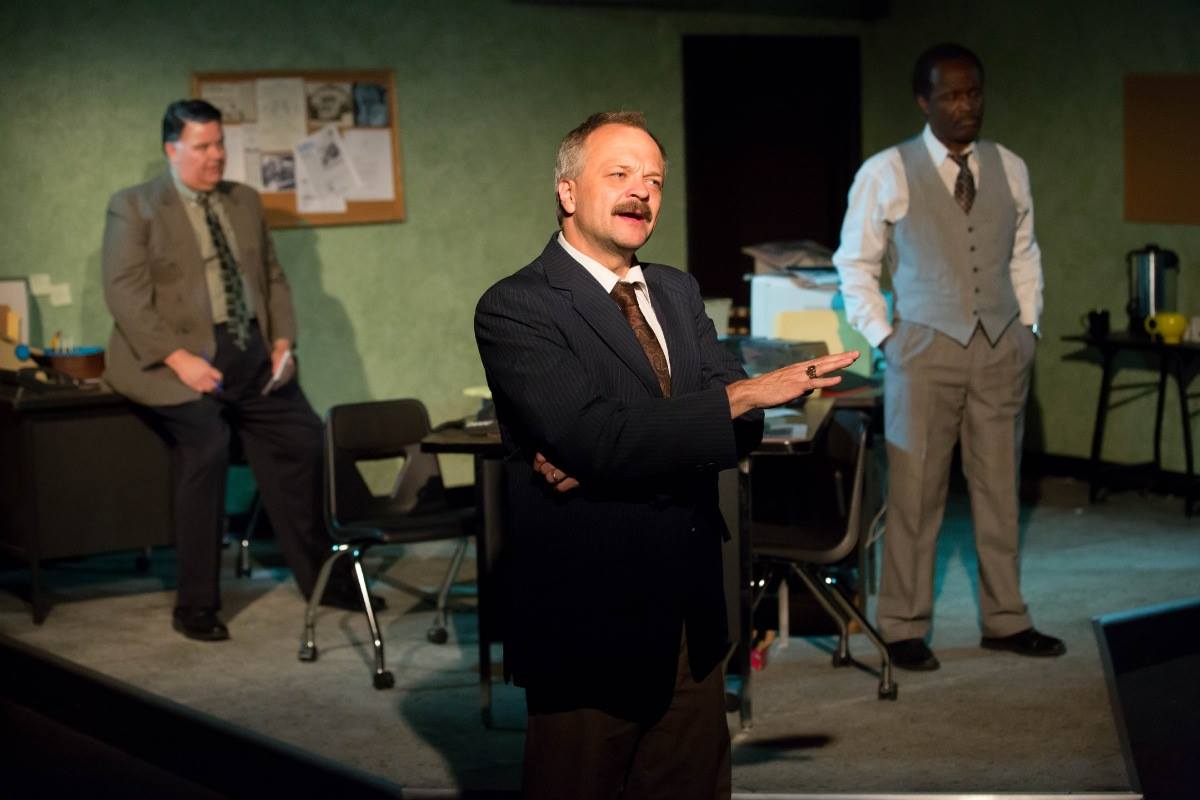
L-R:  Michael O'Shea (Jim Dwyer), Andrew Uhlenhopp (Mike McAlary), Dwayne Carrington (Hap Hairston).
Andrew Uhlenhopp’s McAlary is witty, wise, reckless, and always focused on getting to his next big thing, whether that’s a scoop or a promotion.  Uhlenhopp strikes a perfect balance; we're not sure if we should root for McAlary or fear his ambition and recklessness.  

Cotter (Wade Livingston) gives McAlary an important piece of advice:  reporting is NOT about the 5 w’s (who, what, when, where & why) you learn in journalism school.  Cotter teaches him that there’s only one truth in any story, and to get it, you go to the morgue and count the bodies.  “Everything else is open to interpretation.”  That’s both a cynical and a sadly accurate assessment of journalism, and Livingston's sincere delivery reveals the fairy tale of objectivity we expect from reporters.  Uhlenhopp and Livingston have a  healthy respect for each other as actors, and it shows.  They click.  They are always and completely credible. 

Dwayne Carrington is Hap Hairston, McAlary’s editor and mentor.  Carrington brings his gravitas to managing the herd of cats that is Mike McAlary.  One wouldn't envy Hairston’s difficult task, and Carrington gives us the head scratching, arm crossing, deep sighing performance that fully conveys his frustration with his friend and subordinate.  This may not have been Carrington’s best outing; his timing seemed off by a half a beat at times.  Still, the bond between Carrington and Uhlenhopp was a special one here, and it is so genuine that you can’t take your eyes off either of them when they are onstage.

Abby Apple Boes (Alice McAlary).
Abby Apple Boes (Alice McAlary) and Lara Maerz (Louise/Debby) are talented actors, but both are sentenced to roles that provide little challenge.  Ephron apparently wrote Lucky Guy literally for the “guys;” the women in the show get few lines and minimal development. 

The cast, the direction, and the technical crew here hit all the right notes.  This is a rock ‘em sock ‘em, gritty production of an excellent script.  Ephron has a message for us in Lucky Guy, and The Edge drops that message on us like a ton of bricks.

What kind of guy was McAlary?  He was able to get people to talk to him, which gave him an opening into many of his stories, but he alienated powerful people in the process.  He was adept at exposing corruption at NYPD, and there are often consequences for calling out cops.  One of the corrupt NYPD officers McAlary exposed committed suicide the day after he interviewed him.  In the end, whether McAlary was a hero or a villain depends on your point of view.  The only truth in McAlary's story may be the body count.  The rest is open to interpretation.

Being the most successful columnist in New York City also had rewards, including lucrative paydays and a Pulitzer Prize for Commentary.  The story that won him the praise and the Pulitzer Prize was his coverage of Abner Louima.  

Louima was a Haitian immigrant living in New York City when he was brutalized by NYPD police officers.  The details are too brutal and gruesome to go into in a review, but if you’re unfamiliar with the matter, you can find the details here.  McAlary’s writing exposed the NYPD officers, a number of whom faced criminal charges.  One of those officers, Justin Volpe, was sentenced to 30 years in prison, without parole, for his part in the torture.  He is due to be released in 2025.  A civil lawsuit against the NYPD resulted in a multimillion dollar settlement for Louima.  

The Louima case, and McAlaray’s exposure of it, was the pinnacle of his career.  The play correctly portrays him as leaving his chemotherapy treatment to interview Louima.  It’s a heartbreaking scene; Louima (Andre Hickman) recounts the sordid details to McAlary as he is recovering from his injuries.

Ephron’s script and The Edge do justice to McAlary and Louima, but it’s a difficult story to watch.  The audience sees McAlary as endlessly immersed in seediness, finding and fanning flames of corruption, evil and power for his own ends.  That he won a Pulitzer Prize as a result of the savagery visited upon Mr. Louima seems at once ironic and repugnant.  If ever anyone was unjustly enriched by another’s suffering, it was Mike McAlary.  That the criminals in blue were brought to justice because of McAlary is some relief, but no court can ever bring justice to Abner Louima.

McAlary specialized in exposing the dark side of society and the depravity of some of the people we are taught to trust.  For that reason, I cannot help but appreciate what McAlary accomplished.  At the same time, however, I cannot help being appalled and horrified by the darkness that he found and showed us.

Ephron calls her script Lucky Guy.  Whether McAlary was a “lucky guy” is debatable.  He was a "successful guy" who made a career of swimming in the deepest, most putrid waters of a moral sewer.  That he won a Pulitzer Prize was not luck; it was reliable informers, a cooperative victim, hard work, and sensational writing, but it was not luck.  He died at 41 of cancer, which, in my world, makes him an “unlucky guy."  

Ephron and The Edge are doing something very important here.  This is a true story; one that made me squirm.  It jumbles the journalistic ethics.  It makes crime pay for McAlary.  But mostly it forces us to look at a part of our world we’d rather not see.  We look in a mirror at Lucky Guy and shudder.  The harder it is to look in that mirror, the more important it is that we do so.  Lucky Guy is like a reality show without winners.  There are only villains and victims who unwittingly play the game for the benefit of the writers and readers of tabloids.  Lucky Guy is a stark reminder that theater sometimes serves us best when it shows us our worst flaws.

Cast of Lucky Guy and newsroom set.


NOTES:

There is ample free parking at and near the theater.  Lucky Guy, like all shows at The Edge, is general admission.  However, since it’s a small venue, there’s no need to arrive early.  There’s not a bad seat in the house.  You won't be further than 10 feet from the stage no matter where you sit.

One of the trademarks of an accomplished actor is the ability to stay in character when something goes wrong on stage.  Andrew Uhlenhopp put on a clinic for actors at this performance.  He had to run offstage to get to his next story, but in the process, tripped, tumbled, and crashed into a heap on the floor.  He bounced back up and, totally in character, quipped “I’m in such a hurry to get to my next story I nearly killed myself.”  Not only was that an excellent improvisation, but it reassured the audience that he wasn’t seriously hurt in the fall. 

A detailed account of the Abner Louima case can be found here

This show has adult content and adult language, but should be suitable for most teens. 


PHOTO CREDITSThe Edge Theater, RDG, Rachel Graham.

TICKETS HERE:  

This show will close on July 5, 2015.


PRE/POST SHOW DINING RECOMMENDATION:
We went to Max’s Mexican Restaurant at 6999 W. Colfax in Lakewood.  It’s literally just a few steps from the theater.  For those who have dined at a Mexican restaurant on West Colfax that features cliff divers, you need to check out Max’s.  Authentic Mexican food in a simple, rustic setting.  

The food is very good, the prices are low, and the staff is very friendly.  Yelpers give it 4 stars.  

If you want cliff divers, you know where to go.  If you want good Mexican food near The Edge, go to Max’s.  

Parking is on the west side of the building.

CREATIVE TEAM:

Producer:  Rick Yaconis

Director:  John Ashton

Scenic Designer:  Christopher M. Waller

Lighting Designer:  Kevin Taylor

Sound Designer:  Ren Manley

Costume Designer:  Erin Leonard

Fight Director:  Scott Bellot

Stage Manager:  Katie Espinoza

Assistant Stage Manager/Bartender:  Andrew KC Nicholas


CAST:

Mike McAlary:  Andrew Uhlenhopp

Alice McAlary:  Abby Apple Boes

John Cotter:  Wade Livingston

Hap Hairston:  Dwayne Carrington

Michael Daly:  Tupper Cullum

Jerry Nachman/Stanley Joyce:  Matthew Blood Smyth

Abner Louima:  Andrew Hickman

Bill Bratton:  Hack Hyland

Video Reporters:  John Ashton, Susie Scott

Dino Tortorici/Newstand Guy/Wilse/Editor #1:  Jacob Abbas

Eddie Hayes:  Kevin Hart

Louise Imerman/Debby Krene:  Lara Maerz


Monday, June 22, 2015

Wittenberg


Playwright:  David Davalos


Venue:  University Theatre, 261 UCB, Boulder CO, 80309

Running Time: 2 hours, 15 minutes (includes 15 minute intermission). 

Date of Performance:  Sunday, June 21, 2015.  Regional premiere.

Hamlet is a fictional character in William Shakespeare’s Hamlet, making it unlikely that he and Martin Luther ever met.  Likewise, Johann Faustus is more legend than man, but all three (Luther, Hamlet, and Faustus) have deep philosophical and religious discussions in David Davalos’ script for Wittenberg.  Not only do the actual and fictional characters meet and interact, but at times they careen from profundity to comedy, with somewhat jarring results.  Wittenberg is a prequel to Shakespeare’s classic; but unlike the bard’s tragedy, playwright David Davalos puts the Prince of Denmark in a modern mashup of 16th century ideas, contemporary music, and witty repartee.

Luther is a man of the cloth, deeply troubled by the Catholic church’s selling of indulgences.  His faith challenged, he prepares his 95 theses arguing against the Church practice of profiting from promises to get people to heaven.  

Johann (John) Faustus, by comparison, is a man of “choices.”  He’s part hedonist, part philosopher, and a harsh critic of Luther’s religious beliefs.  The two argue their positions, making it apparent that Luther's religion and Faustus' philosophy are, at their cores, incompatible.  Philosophers seek to explain life through facts; religion explains life through faith in a Supreme Being.  

It is this clash of existential belief systems that playwright David Davalos focuses on, using the fictional and historical characters to flesh out these mutually exclusive belief systems.  As both Luther and Faustus are on the faculty at the University of Wittenberg, they make their arguments to Hamlet, their promising if indecisive student.  
The construction here may seem somewhat familiar to those who have seen the play Picasso at the Lapin Agile.  Actor/comedian/director/writer Steve Martin used a similar fictitious meeting between Pablo Picasso and Albert Einstein to explore the nature of talent and genius.

Davalos’ script, though, lacks a certain balance; Luther gets the worst of the debate at nearly every turn.  Faustus (Lawrence Hecht) is a master of cold logic; he’s an empiricist.  He believes only what he can prove, and considers Luther’s faith to be foolish and misguided.

Luther (Howard Swain) is hardly in a strong position to debate Faustus; he is on the verge of inspiring a revolution against the Catholic church.  Given his crisis of faith and complete distrust of some core Catholic beliefs, he is at a rhetorical disadvantage.  Fortunately for him, Hamlet is so indecisive that he could be persuaded by Luther’s passion if not his logic.
Howard Swain (Luther), Benjamin Bonenfant (Hamlet), Lawrence Hecht (Faustus).

Both Hecht and Swain have juicy roles, and they pump them for every scrap of wit, irony, and profundity they can muster.  Hecht does hedonism with a wink and a smile.  He’s like a kid in a candy shop with a $50.00 bill in his pocket.  Hecht goes from euphoric kid in the first act to defeated, demoralized, and confused when he realizes his life has no real meaning or purpose.

Howard Swain (Martin Luther).
Swain plays Luther as a troubled but devoted believer who is working up the courage to be a heretic.  Swain is exquisite when he goes into raging rants about Johann Tetzel, the Grand Commissioner of Indulgences.  He is sincerely humble when he asks Hamlet (Benjamin Bonenfant) to read his 95 theses.  And Swain is suitably stoic when Faustus confronts him with “choices.”  

Bonenfant is a marvelous Hamlet.  He plays along with both Luther and Faustus, working both sides of the philosophical fence.  Bonenfant has his own subtle debate over whether and how to someday become King of Denmark; he shows us how the man we know from Shakespeare came to be.

Mare Trevathan (The Eternal Feminine).
Mare Trevathan plays “The Eternal Feminine,” which is really four roles here:  Gretchen, a working girl, Helen, a lady of pleasure, Mary, the Mother of God, and Lady Voltemand, an ambassador.  Trevathan rocks the role for every one of these ladies, and she gets to wear some of the best costumes in the show.  

Director Timothy Orr is telling a compelling story here, with big ideas, heavyweight characters, and constant nods to the bard.  (Faustus’ room number?  2B.)  The script is a delicate mix of the profound and the comic, and Orr handles each with skill and reverence.  He blocks an imaginary tennis match; Hamlet has a real racket but an imaginary ball.  The scene is funny, which is the intent, but Orr has combined light, sound, and action so well that we can almost see the ball.  In a show with a lot of memorable moments, this scene
Benjamin Bonenfant (Hamlet), tennis match.
stands out.

Orr has also used music to enhance the message.  It’s contemporary, and a bit jarring.  After the philosophical debate in the first act, in which Faustus derails Luther at every turn, the audience returns to their seats for the second act to the Rolling Stones’ Sympathy for the Devil.  After the music dies down, the second act opens, and there he is.  Lucifer himself.  Faustus is dressed up for Halloween as the devil incarnate.  

Wittenberg is an interesting take on Hamlet, Luther, and Faustus, but overly ambitious.  Had it been based strictly on the philosophical/religious debate, the story would have been more focused.  Scripting Luther with a more aggressive defense of religion would have added some needed balance, as well as historical accuracy.  The clash of big ideas comes off more as a crash of both ideas.  In the end, neither argument is persuasive, even after Faustus rolls over Luther in the first act.  Ironically, Luther lost the debate, but 500 years later, no one remembers Faustus.  Luther, on the other hand, changed the world.

Davalos’ comedy is often inside jokes; besides the Shakespeare references, there are also a number of jokes targeting academia (you can’t do that…”I have tenure!”).  That humor plays well in Boulder, but it is less amusing the farther you go from a college campus.  

If you’re a fan of the bard, this is tempting fare.  If you love send ups of classics, this could be your cup of tea.  If you prefer your live theater to deal with profound questions, Wittenberg does that.  If you’re a fan of talented actors pulling out all the stops for their art (I count myself in this group), you’ll love these actors.  There’s a lot to recommend in Wittenberg.  That said, however, I was entertained by Wittenberg, but not enlightened.  I was hoping for both.


NOTES:

Parking near the theater is difficult. Plan to arrive early enough to hunt for a suitable parking spot.  There is a public paid lot nearby at Broadway and Euclid.  Weekends are a flat fee of $4.00, and it’s a short 5 minute walk from the lot to the theater.

If you need to go to Will Call on arrival, it’s one floor below the actual theater.  

This show is suitable teens. 


PHOTO CREDITSColorado Shakespeare Festival (photos by Jennifer M Koskinen).

TICKETS HERE:  

This show will close on August 8, 2015.


PRE/POST SHOW DINING RECOMMENDATION:

We had brunch with friends before the show at Turley’s Restaurant, 2805 Pearl Street, Boulder, 80301.  It was Father’s Day, so we anticipated a big crowd at any restaurant, and Turley’s certainly had a full house.  The wait, however, was short, and when we didn’t immediately respond to a page, they came looking for us.

Turley’s is about a 5 minute drive to/from the theater.  Service was fine, as was the food.  They specialize in “healthy casual” food, with a lot of organic ingredients (including grass fed organic ground beef), and a range of gluten free options.  The food was delicious.  If you order something that includes a “biscuit,” you’ll be very pleasantly surprised.  It’s the biggest homemade biscuit I have ever seen, and it is the perfect complement to any breakfast/brunch choice.  We will be back…


CREATIVE TEAM:

Director:  Timothy Orr

Scenic Designer:  Caitlin Ayer

Lighting Designer:  Jason Banks

Sound Designer:  Jason Ducat

Costume Designer:  Hugh Hanson

Fight Director:  Geoffrey Kent

Assistant Director/Dramaturg:  Wesley Longacre

Stage Manager:  Paul Behrhorst

Assistant Stage Manager:  Kristen Littlepage


CAST:

Hamlet:  Benjamin Bonenfant

John Faustus:  Lawrence Hecht

Martin Luther:  Howard Swain

The Eternal Feminine:  Mare Trevathan


https://theatercolorado.blogspot.com/b/post-preview?token=TARfJE4BAAA.tZt_L-oA8UWeVSOopMcqZw.WXiK7ji9jYBItkoFCd7KDQ&postId=979733997683163772&type=POST

Monday, June 15, 2015

Driving Miss Daisy


Playwright:  Alfred Uhry


Running Time: 1 hours, 45 minutes (no intermission). 

Date of Performance:  Saturday, June 13, 2015. 

Driving Miss Daisy at the Cherry Creek Theatre has set some records for the first two weekends of its run.  It sold out opening night.  It sold out opening weekend.  It sold out all three performances on the second weekend.  From what I saw, it will sell out the entire run, so if you have the faintest interest in seeing a splendid production of a beautiful script, buy your tickets now.  You will not be disappointed, unless you are unable to score a seat at Driving Miss Daisy.

Billie McBride (Miss Daisy).
The cast is small; only three actors.  Those three actors combine, however, for what is best described as an “All Star” cast.  Billie McBride plays Daisy; she is well known in Colorado theaters as a polished professional with a long resume.  Billie has a number of Broadway and off Broadway credits, including Torch Song Trilogy, and a substantial list of television credits.  Cajardo Lindsey (Hoke) is a company member at Curious Theatre and probably has a trophy case at home full of his numerous awards.  Mark Collins (Boolie) is a well known actor in the Denver area, having recently appeared in Jerusalem and The Beauty Queen of Leenane at the Edge theater, as well as The Cripple of Inishmaan at Miner’s Alley.  

Putting McBride, Lindsey and Collins together for Driving Miss Daisy is a masterful act of casting; the trio lights up the stage with brilliant performances from the first scene to the extended standing ovation.  
Cajardo Lindsey (Hoke).

Director Pat Payne fully exploits the wealth of talent he has been given.  Payne paces the show at the speed of a Southern drawl, giving the dialog an inherent authenticity.  Driving Miss Daisy does not require a real or even a mockup car to work; Payne arranges wooden chairs for the front and back seat.  The rest is done with imagination and creativity.  Payne ages his actors during the 30 years covered in the script, slowing them down and showing their physical and emotional struggles as they age.

For reasons both practical and artistic, Payne needed a simple but effective set.  Set designer Tobias Harding delivered exactly that with a three piece set that works extremely well.  Besides the imaginary car, the set includes a work desk for Boolie and an easy chair for Daisy’s living room.  Lighting designer Karalyn Star Pytel keeps the active 1/3 of the set lit while the other 2/3 is dark.  

Mark Collins (Boolie).
Dialect coach Gabriella Cavallero’s work is obvious and outstanding.  All three actors speak fluent Southern.  I am constantly amazed at the ability of good actors to adopt a dialect for their performances.  McBride appeared recently in The Lying Kind with a marvelous British accent; Collins had a heavy Irish brogue in The Cripple of Inishmaan.  Hearing them here with a Southern drawl is additional (but perhaps unnecessary) proof of how well they have mastered their craft.  

Carjardo Lindsey’s southern drawl is just as effective, but it’s something we’ve seen before.  He played a similar character in The Whipping Man.  Both roles are for an old African American man in the South.  Offstage, Lindsey is an imposing young guy with a million dollar smile.  Onstage, he can age 50 years with ease.  Watch him getting into the imaginary car.  Using his free hand, he lifts his trailing leg at the knee and drags it into the car.  It’s a completely authentic gesture that fully conveys the struggle of aging.  Lindsey has a day job; he’s a practicing attorney (complete with an ad in the program).  His acting hobby may one day overtake his day job.  He’s that good.

I haven’t said much here about the story or the plot.  If you’re unfamiliar with Driving Miss Daisy, all you need to know is that it won the Pulitzer Prize for Drama in 1988.  It is a compelling story, chronicling a changing Atlanta during the mid 20th century civil rights movement.  It’s done here by an amazing cast at the top of their games, and that alone makes this a must see show.  

Driving Miss Daisy is intimate, personal, and outstanding theater in the most unlikely of places:  a carpet store.  This is a very small venue; all the seats are within a few feet of the actors.  Broadway is not the only place to see great theater; sometimes it happens where you least expect it.  

Don’t go to Broadway.  Go to Shaver-Ramsey Fine & Custom Rugs in Cherry Creek.  It won’t cost you a fortune (tickets are just $34.00), and you’ll be close enough to see every gesture, every facial expression, and every nuance on the stage.  I guarantee that for your $34.00, you will get an unforgettable theater experience that will rival any show on Broadway.  

NOTES:

There is metered street parking parking near the theater on the surrounding streets.  There are also nearby paid parking structures, and potential free parking at the Cherry Creek Mall garages.  That said, though, parking near the theater is difficult. Plan to arrive early enough to hunt for a suitable parking spot.

This show is suitable for all ages. 

And now, a word from our sponsor....

Sponsors and supporters of local theater do not get enough credit; without them, most small companies could not exist.  That’s the case with Cherry Creek Theatre as well.  They need donors, supporters, and sponsors as well as ticket sales to put on quality theater.  I’m taking a little space here to recognize one of their benefactors.

Shaver-Ramsey Fine & Custom Rugs. 
The Shaver-Ramsey carpet store generously makes its space available to the Cherry Creek Theatre group.  I have no idea what the arrangement is between the two entities, but Shaver-Ramsey has been home to Cherry Creek Theatre for years.  Each time a show takes place, no carpet business is done in the store.  I’m sure there is some lost business factor for Shaver-Ramsey, but there is a huge art benefit to the entire Denver community.  

I, for one, am very grateful for sponsors like Shaver-Ramsey.  So here’s my thanks…a virtual STANDING OVATION.  And if I need a new custom carpet, I’ll be in to take a look around.


PHOTO CREDITS:  BK Studios & Shaver-Ramsey Fine & Custom Rugs.

TICKETS HERE:  

This show will close on June 28, 2015.


PRE/POST SHOW DINING RECOMMENDATION:

This is a description rather than a recommendation.  I doubt we’ll go back.

We had dinner with friends before the show at The North Italia restaurant, 190 Clayton Lane 
Denver.  It’s high end Italian, and it’s in Cherry Creek, so plan to spend some money.  We had a beer, a sangria, a pizza ($15.00), and spicy shrimp ($18.00).  Our check was around $70.00 before the tip.  My pizza exploded with flavor.  Roxie’s shrimp pasta was adequate, but for the price, it was undistinguished.  The best part of the experience was the unhurried dinner conversation with our friends.

North Italia is very convenient to the theater, which is less than three blocks away.  Once you’re parked, you don’t need to move the car. 


CREATIVE TEAM:

Director:  Pat Payne

Dialect Coach:  Gabriella Cavallero

Set Designer:  Tobias Harding

Lighting Designer:  Karalyn Star Pytel

Sound Designer:  Tom Quinn

Costume Designer:  Debra Faber

Wigs:  Debbie Spaur

Props:  Rob Costigan & Bob Bauer

Stage Manager:  Lisa Cook

Assistant Stage Manager:  Lauren Hergenreter

Publicist:  Gloria Shanstrom


CAST:

Daisy Werthan:  Billie McBride

Boolie Werthan:  Mark Collins

Hoke:  Cajardo Lindsey


Sunday, June 14, 2015

Barefoot in the Park


Playwright:  Neil Simon


Venue:  Cottonwood Center for the Arts, 427 East Colorado Avenue, Colorado Springs, CO.

Running Time: 2 hours, 30 minutes (includes one 20 minute intermission and one 10 minute intermission). 

Date of Performance:  Friday, June 12, 2015. 

There’s little question that Neil Simon is one of the most successful American playwrights of the 20th century.  In 1966, he had four (4) shows open simultaneously on Broadway:  Sweet Charity, The Star Spangled Girl, The Odd Couple, and Barefoot in the Park.  Few playwrights dream of such success; Simon achieved it early in his Broadway career.

Barefoot in the Park premiered on Broadway in 1963, making the script 52 years old this year.  Star Bar Theater Company’s revival at the Cottonwood Center is a fresh production with fresh faces in a script that is now a 20th century New York period piece.

For those few who may be unfamiliar with Barefoot in the Park, it’s a romantic comedy with some drama baked in as newlyweds Corie (Kerry Brooke Steere) and Paul (Kevin Brown) move into their first apartment in New York City.  As with most young couples, the apartment is hardly a dream home; it’s tiny, it’s an exhausting five floor climb (six counting the stoop), and it’s a building filled with eccentrics.  

Mix in Ethel Banks (Dessa Baxman) Corie’s smothering mother, and Victor Velasco (Warren Epstein), their odd upstairs neighbor who has visions of grandeur with not nickel to his name, and you have a recipe for both comedy and conflict.

Simon’s script takes the newlyweds from bliss to bitchy in the blink of an eye.  What started as unconditional love turns into heartbreak and breakup.  Barefoot in the Park is a comedy, but one with a lesson about love.  Relationships are hard work, even for those just starting out together.

Kerry Brooke Steere and Kevin Brown bring a natural chemistry to their roles; they are engaged to each other offstage.  Their couple status helps them look like, sound like, and act like Simon’s fictitious couple.  Brooke Steere is a bouncy, impulsive, and hopelessly infatuated Corie until she summons her angry demons and kicks Paul out of the apartment.  Brown’s impeccably dressed but boring Paul is suitably shocked when Corie turns on him.  Brown and Brooke Steere bring their characters to life, making them credible and lovable even when they melt down.
 
I should mention here that Brown ties his necktie onstage, without a mirror.  He gets it right; it looks perfect.  Given the few occasions anymore when any male actually needs to know how to tie a necktie, Brown’s onstage demonstration is impressive. 

Warren Epstein has a quirky role here as Victor.  Epstein skillfully walks the line between beggar and genius, giving Victor a convincing charm.  A gourmet, Victor presents the cast with a salted eel dish that must be eaten in compliance with a very strict regimen.  Epstein pulls it off with flair and fun, dragging the other characters along, warning them all not to nibble at the dish but to just devour it in a single bite.

Dessa Baxman brings the nuances of Corie’s mother to the Star Bar stage; she has a way of criticizing Corie without saying a word.  Her slight eye rolls and glances at Corie carry the full weight of maternal disapproval.  In a bit of a role reversal, Baxman has to finesse her way through getting caught in a compromising situation.  She awkwardly explains to her daughter why she is wearing Victor’s robe.  Her explanation is plainly weak, but Baxman delivers it with a panicked sincerity.

Sarah Sheppard Shaver has dressed the cast in colorful costumes, from Paul’s "stuffed shirt" suit and tie to Victor’s kimono and hat.  Elizabeth Kahn’s set design is functional and flexible; the apartment goes from stark and empty in act one to decorated and fully furnished in act two.  Director Wes Whatley balances the comedy and the conflict gracefully, making Simon’s relationships as important as the laughs.

It is those relationships that the audience will remember here.  Love requires work, and that has not changed in the slightest in the last 50 years.  

Neil Simon fans can now bare their claws and pounce on me at will.  In my view, some of his work has not held up very well to the test of time.  What was funny in 1963 seems quaint in 2015.  This is not a knee slapping, laugh out loud show.  It is amusing.  It will create some laughs and a lot of smiles, but few belly laughs.  Compared to contemporary romantic comedies (Friends with Benefits, or Sex and the City, for example), Barefoot in the Park comes off as tame and quaint.  A lot has changed since 1963, and Simon’s comedy has lost some of its edge.

Still, Barefoot in the Park is a Neil Simon classic, and fans of the playwright will be pleased with Star Bar’s production.  It’s an engaging, charming, and altogether entertaining show done by a talented cast.  


NOTES:

There is ample free street parking parking near the theater on the surrounding streets.  There is also parking in the parking lot across the street.

This show is suitable for all ages.  In fact, a four year old girl was seated in front of us on opening night.  

The theater is on the second floor, but there is an elevator for the mobility impaired.  Ask at the first floor box office for details.


PHOTO CREDITSStar Bar Theatre Company

TICKETS:  

Tickets are $15

$12 senior/military/veteran

$6 for students (student tickets available at box office only; sorry, no reservations)
Sunday Special:  Pay-what-you-can! (at door only).

Tickets reserved online will be waiting for you at the box office on the evening of the performance.  Unfortunately we cannot guarantee seating for reservations made after 5PM on the day of the performance. Student tickets are $6 and are available at the box office only.

This show will close on June 28, 2015.


PRE/POST SHOW DINING RECOMMENDATION:

We had dinner before the show at the Phantom Canyon Brewing Company, 2 E. Pikes Peak, Colorado Springs.  Established in 1993, it’s the oldest brewpub in the Springs.  At the corner of Pikes Peak and Cascade, you can’t get a more central location.  They have outdoor seating on the sidewalk for those who prefer al fresco dining.  

Happy Hour ($2.75 pints, $3 house wines, $10 pitchers of beer) is 3:00-6:00 and 10:00 PM to closing.  

I had the Chief Lager; Roxie had the Gandy Dancer Smoked Porter.  Both were exactly as described…and delicious.  The fish and chips dinner ($11.00) is my favorite fish and chips anywhere.  Period.  

The House Made Pretzel Bites appetizer is served with freshly baked (and still warm) pretzel pieces.  The dips include beer cheese and whole grain beer mustard.  Not to be missed.

CREATIVE TEAM:

Director:  Wes Whatley

Set Designer:  Elizabeth Kahn

Lighting Designer:  Eli Monroe

Sound Designer:  Bob Morsch

Costume Designer:  Sarah Sheppard Shaver

Stage Manager:  Rebecca Savage


CAST:

Corie Bratter:  Kerry Brooke Steele

Paul Bratter:  Kevin Brown

Victor Velasco:  Warren Epstein

Mrs. Ethel Banks:  Dessa Baxman

Telephone Repairman:  Gary Nowinski


Delivery Man:  David Justice

Wednesday, June 10, 2015

Rough Writers New Play Festival

Rehearsal for A Woman on Paper, by Susan Shafer.  Directed by Eve Tilley.  Photo:  Colorado Springs Independent.

This article can be found on the Colorado Springs Independent website.